
Dangerous Goods Transport Regulations 2025/2026: ADR Updates & EU Requirements
The dangerous goods transport regulations in Europe will become significantly more detailed beginning in 2025/2026. With Delegated Directive (EU) 2025/1801 and the updates based on ADR 2025, inspections, risk assessments, and responsibilities across the entire supply chain for the transport of dangerous goods are being fundamentally redefined.
Short answer: Starting at the end of 2025, the EU introduces a unified ADR inspection checklist, a new risk violation classification system, and clearly distributed responsibilities across the supply chain. Companies in logistics and fleet operations must update checklists, documentation, training, and route planning to comply with the new dangerous goods transport rules and to avoid delays during inspections.
Table of Contents
- Why the Regulations for Dangerous Goods Transport Are Being Updated
- Unified ADR Checklist: What Is Now Inspected
- New Risk Categories for Violations
- Shared Responsibility Across the Supply Chain
- Documentation Requirements & Digital Proofs
- Impacts on Training, Planning & Processes
- Conclusion & Recommended Actions
The updated rules for the transport of dangerous goods stem from Delegated Directive (EU) 2025/1801, which aligns existing EU regulations with ADR 2025 and the latest recommendations from the UN Committee of Experts on the Transport of Dangerous Goods. The goal is to create a modern, harmonized inspection framework across the EU.
The revised rules aim to:
- harmonize inspections across the EU,
- increase transparency and comparability of inspection results,
- enhance safety in every dangerous goods transport scenario.
For companies performing regular transport of dangerous goods, this means that previous differences between national inspection practices will disappear—replaced with one standardized rule set.
One of the most visible changes in the updated dangerous goods transport regulations is an EU-wide mandatory inspection checklist. All European enforcement authorities will use the same list, ensuring consistent evaluations.
Main inspection areas include:
- Vehicle: technical suitability, ADR approval, condition of safety-relevant components,
- Tanks and containers: approvals, pressure and leak checks, valves, fittings,
- Markings: hazard labels, UN numbers, orange plates, container placards,
- Equipment: fire extinguishers, PPE, wheel chocks, load securing,
- Documents: transport documents, driver ADR certificate, approvals, written instructions.
Each inspection point is linked to a specific ADR rule, which eliminates interpretation issues and clearly shows companies what they must fulfill during every dangerous goods transport.
In practice, this means more systematic and verifiable pre-checks. Many companies already use digital checklists within tour or assignment planning to identify issues before departure.
The directive introduces a clear three-level risk system for violations during the transport of dangerous goods. These categories determine how authorities respond to issues found.
- Category I – High Risk
Examples: missing ADR driver certificate, leaks, severely incorrect marking.
Result: immediate vehicle immobilization. - Category II – Medium Risk
Examples: non-functional fire extinguishers, incomplete equipment, incorrect marking.
Result: must be corrected immediately. - Category III – Low Risk
Examples: minor documentation errors.
Result: correction allowed after the inspection.
Dispatchers and fleet managers benefit from detecting and documenting deviations early to avoid expensive downtime and re-inspections.
Another major update in the new dangerous goods transport regulations is the precise definition of all participants and their responsibilities. This eliminates many common ambiguity issues in the transport of dangerous goods.
The directive explicitly names:
- Shipper,
- Carrier,
- Consignee,
- Loader,
- Packer,
- Filler / Tank operator,
- Unloader.
Each participant has clearly defined duties. Liability therefore spreads across the supply chain rather than concentrating on the carrier alone.
Many companies already document responsibilities directly in the transport order to reduce sanction risks and maintain a clear traceability chain.
The directive clarifies what documentation must be carried in the driver's cabin during a dangerous goods transport and under which conditions digital documents may be used.
Typical mandatory documents include:
- Transport documents with UN numbers, proper shipping names, and classifications,
- ADR driver training certificate,
- Vehicle and tank approval certificates,
- Written instructions (ADR),
- Special permits or exemption documents if applicable.
Digital documents are allowed only if access is immediate and reliable. Lack of documentation can result in:
- vehicle immobilization,
- administrative penalties,
- increased inspections for recurring issues.
Because of this, centrally managed digital documentation becomes increasingly valuable. Many companies rely on transport management systems (TMS) that link ADR documents directly to orders, vehicles, routes, and drivers.
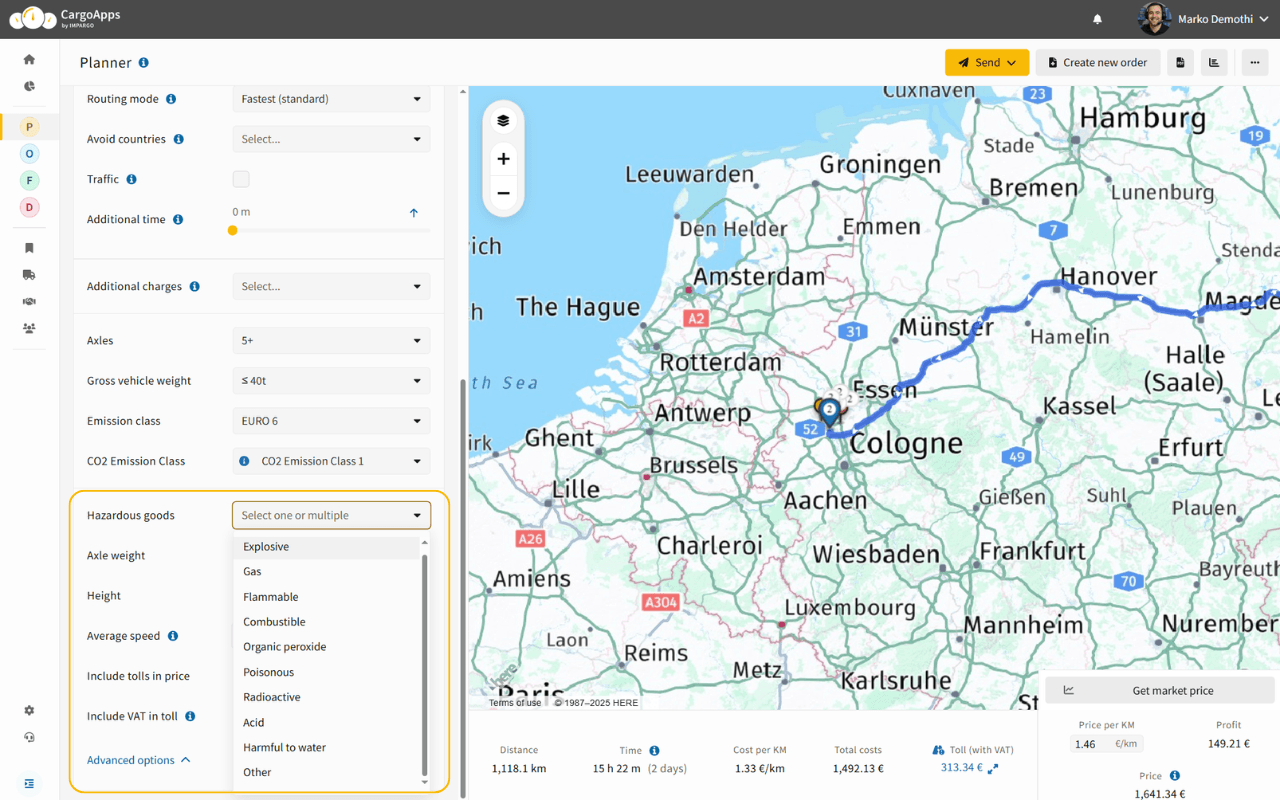
More information about ADR-optimized solutions is available at ADR Transport Solutions for Dangerous Goods .
To meet the new dangerous goods transport regulations, companies must adapt more than just forms and checklists. They need ongoing updates to training, routing, equipment, and internal processes.
ADR Training and Qualifications
- Drivers must hold valid ADR certificates.
- Expiration dates and qualification validity should be monitored.
- Dispatchers, warehouse teams, and supervisors should be informed about the new rules.
While additional training initially increases dangerous goods transport costs, it significantly reduces risks such as downtime, sanctions, and compliance failures.
Planning and Routing
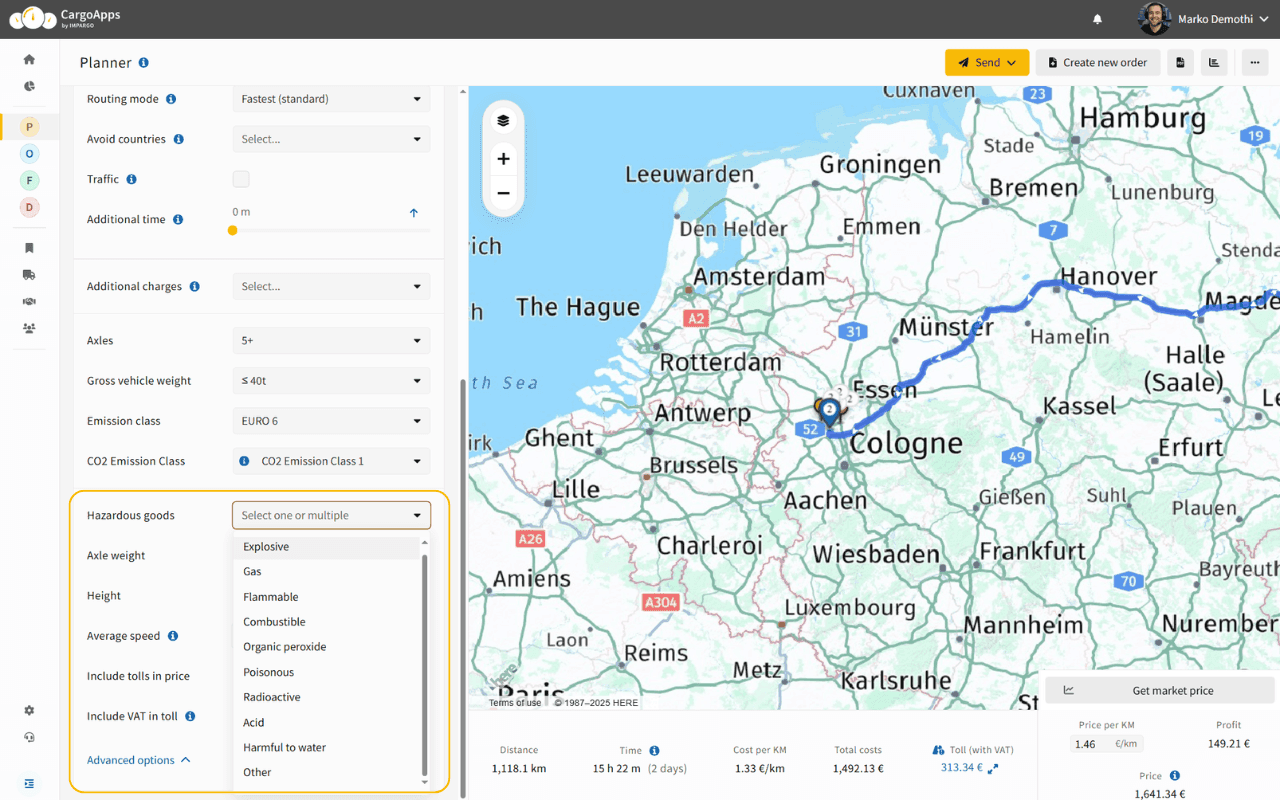
- Routes must consider ADR-restricted zones,
- Hazard classes and quantities influence which roads may be used,
- Tunnel categories, roadworks, and local regulations should be integrated into planning workflows.
Processes & Digital Support
Companies are encouraged to update internal checklists, workflows, and responsibility matrices. Best results occur when these are integrated directly into digital systems such as tour planning, order management, and documentation workflows.
Many companies use IMPARGO for this—because ADR routing, order management, and documentation storage come together in one place, without requiring major workflow changes.
The upcoming updates to the dangerous goods transport regulations bring structure and clarity: a unified checklist, transparent risk levels, and clearly allocated responsibilities. Companies can prepare efficiently if they start early.
- Maintain consistent documentation across all transports,
- Keep ADR training up to date for everyone involved,
- Plan routes in ADR-compliant ways,
- Define responsibilities clearly throughout the supply chain,
- Adopt digital workflows for documentation, routing, and inspections.
Companies already working with digital processes will adapt to the new ADR requirements more easily than those relying on manual paperwork or fragmented systems. Early preparation helps prevent downtime and ensures smooth inspections.
FAQ on the New Dangerous Goods Transport Regulations
What will change in dangerous goods transport in 2025/2026?
The EU introduces a unified ADR checklist, new risk categories, and expanded responsibilities across the supply chain, along with stricter documentation requirements.
When do the new rules take effect?
Delegated Directive (EU) 2025/1801 takes effect at the end of 2025, and most procedures become mandatory from mid-2026.
Which business areas are most affected?
Dispatching, fleet management, warehousing, compliance/quality management, and executive functions are most impacted.
Is it enough to train only drivers?
No. While drivers are central, dispatchers, warehouse staff, loaders, shippers, and consignees must also understand their updated responsibilities.
About the Author
This article was prepared by a specialist editorial team focused on road freight transport, dangerous goods logistics, and digital transport processes. The team regularly analyzes ADR updates, EU directives, and their real-world implications for fleet and logistics organizations.