IMPARGO Knowledge Center

Unleash the full potential of our software with our comprehensive Knowledge Center, offering detailed information on its functionality and features.

  • PLANNER: Truck, Toll & Tour Calculation
  • ORDERS: Order Management
  • ORDERS: Offer Management
  • FLEET: Execute With The DriverApp
  • DISPATCH: The Dispatch Board for Trucks
  • DRIVERAPP: Order Execution & Truck Navigation for Drivers
  • Managing Master Data
  • Analytics
  • Help Center
  • Integrations

Create a Tour from Orders

Table of Contents

  1. Access the Orders Module
  2. Create a Tour from Your Orders
  3. Hub Handover: Split Orders, Then Fuse the Legs
  4. Monitor Tour Status & Events
  5. Unfuse a Tour
  6. Export a Tour as PDF
  7. Find Tours Across Views
  8. Review Important Rules


Dispatchers often manage multiple transport orders that share routes or destinations. Planning these separately can lead to duplicate stops, inefficient use of vehicles, and driver confusion.

The Create Tour from Orders feature lets you combine two or more orders into a single Tour. You can do this in two ways: fuse whole orders directly, or, for hub-based transports, split orders at a hub and then fuse the matching legs. Each order keeps its own record, so dispatchers retain full visibility while drivers receive one clear assignment.


Key Benefits

  • Combine multiple orders into one optimized tour
  • Fuse split legs from hub-based transports (for example, group all runs to a hub into one pickup tour)
  • Merge duplicate stops (pickups or drops)
  • Keep original orders accessible for invoicing and verification
  • Drivers see one simple assignment, dispatchers keep full visibility
  • Export professional PDFs with all customer and order references


Terminology

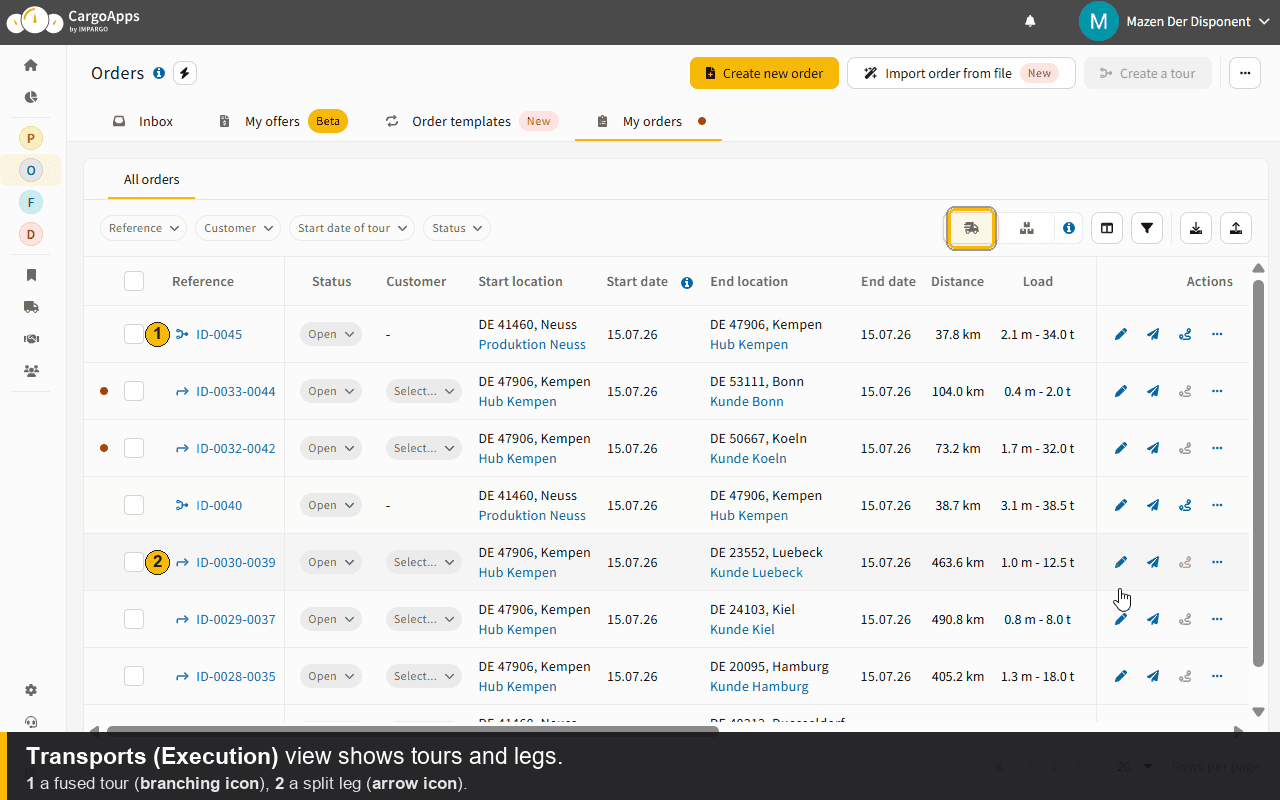
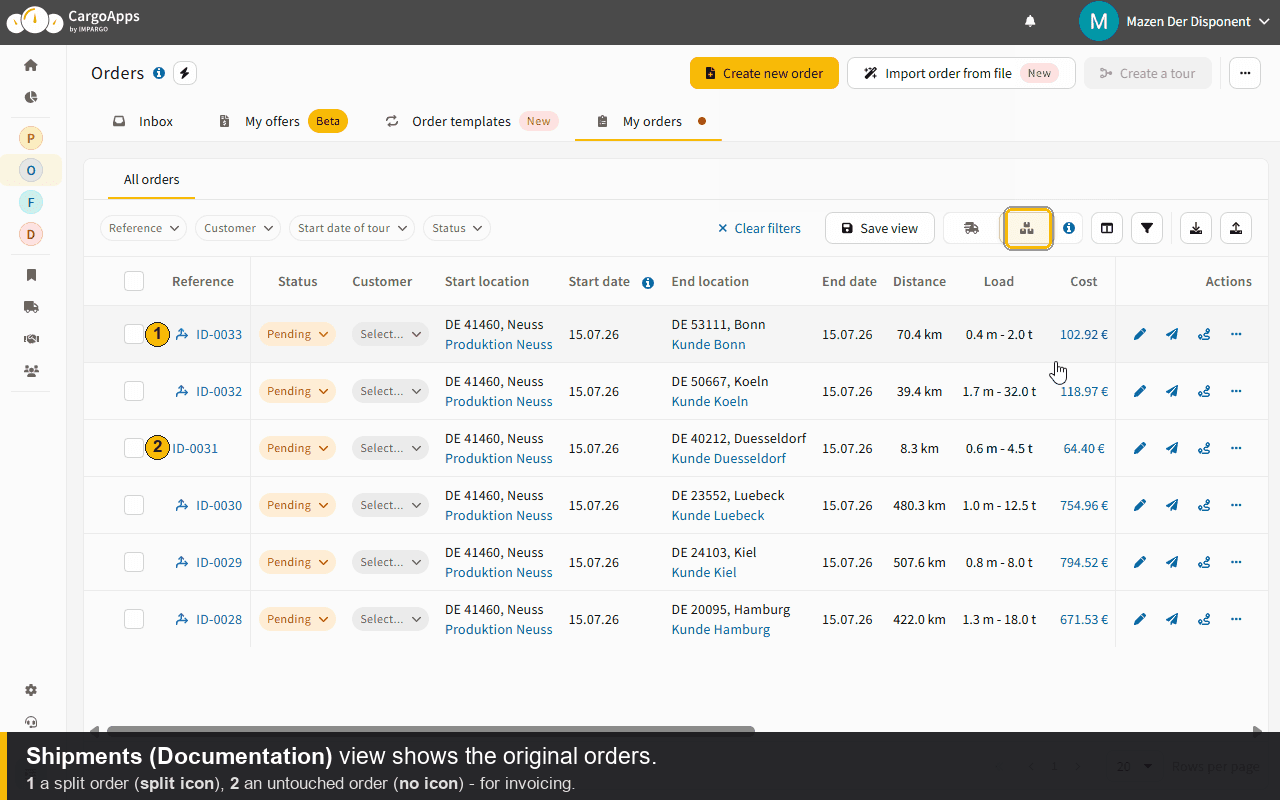
  • Original Order: An order that has not been split or fused. It appears in both the Transports (Execution) and Shipments (Documentation) views and carries no icon.
  • Split Order: An order you have split at a stop (for example, a hub). The parent stays in the Shipments (Documentation) view, while its legs are executed separately.
  • Split leg: One of the two orders created when you split an order (a run to the hub and a run from the hub). A leg can be assigned on its own or fused into a tour.
  • Tour (fused orders): Two or more orders and/or split legs fused into one transport unit. It appears in the Transports (Execution) view with a branching icon.
  • Order in tour: Any order or split leg that has been fused into a tour.
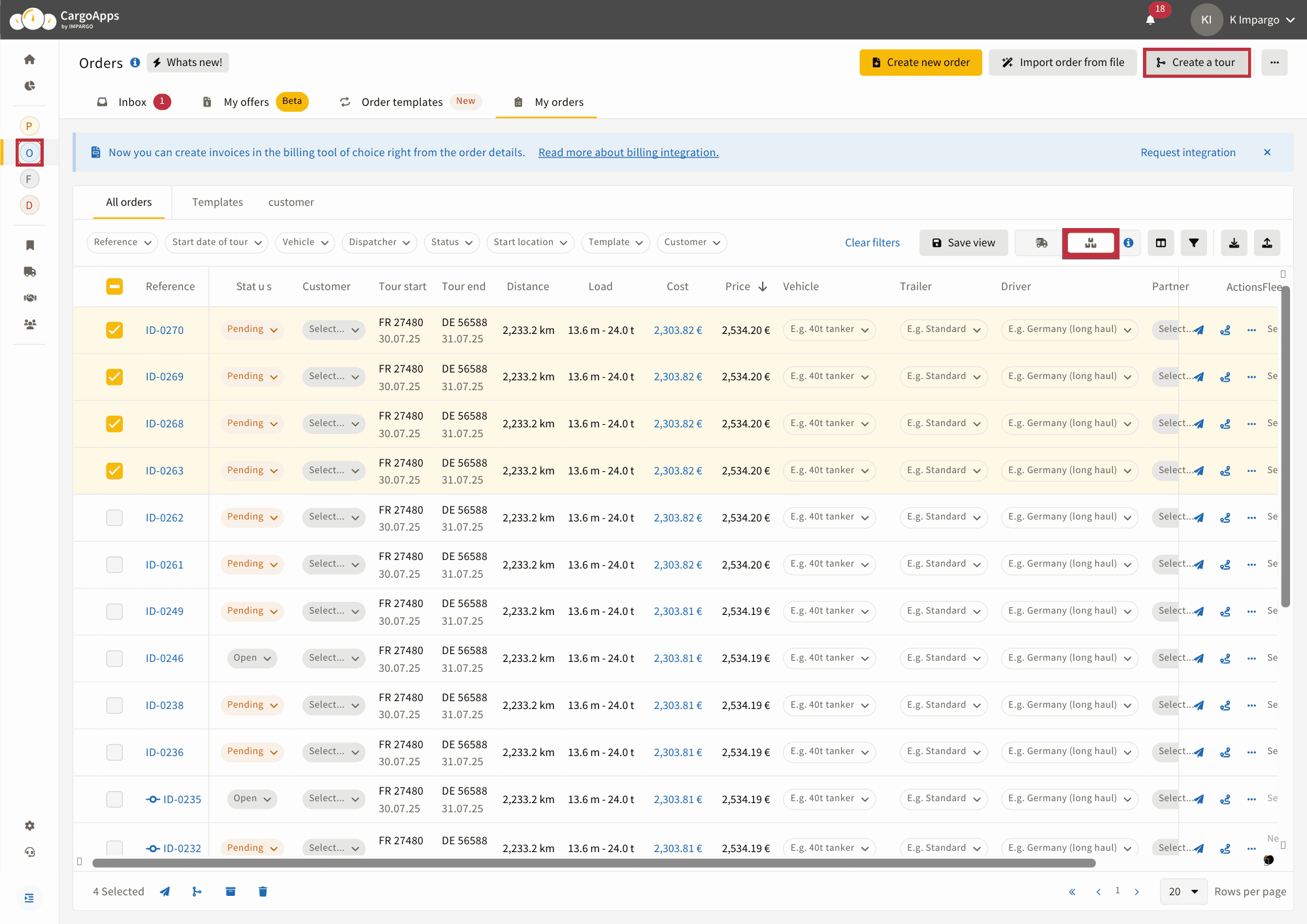
 

1. Access the Orders Module


Step 1: Open the Orders module.   
Click the blue "O" in the left-hand sidebar to access all transport orders.

Step 2: Locate the Create a tour button.   
The button appears in the top-right corner of the Orders table once at least two eligible orders are selected.

Create a truck tour in the Orders module
Find the Create a tour button in your orders table


2. Create a Tour from Your Orders

This is the core workflow for fusing two or more whole orders that share a route or destination. The screenshots in this section show whole orders being fused. If instead you are fusing the split legs of a hub transport, the steps are identical but you select legs rather than orders. That variant is illustrated separately in Section 3.

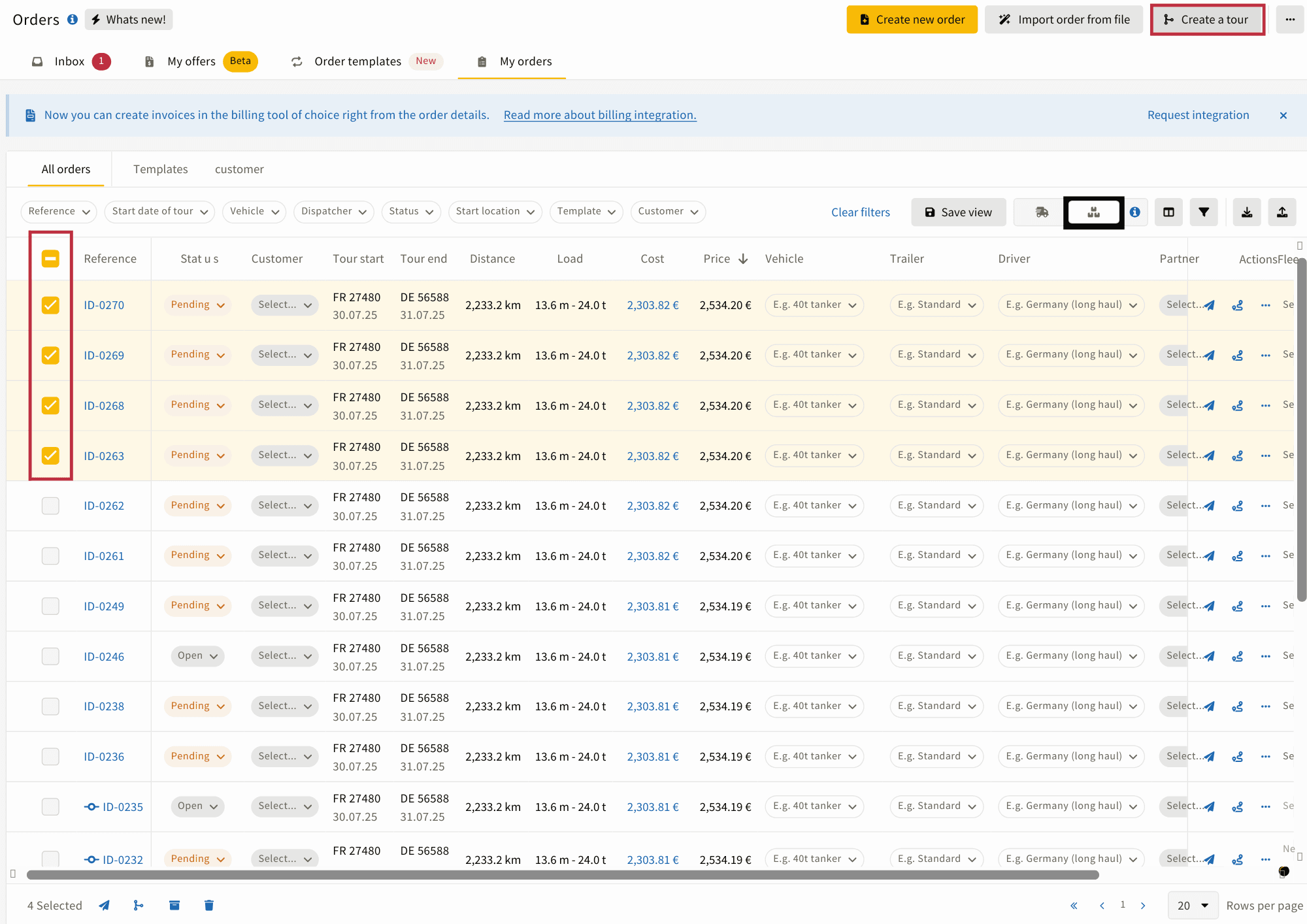
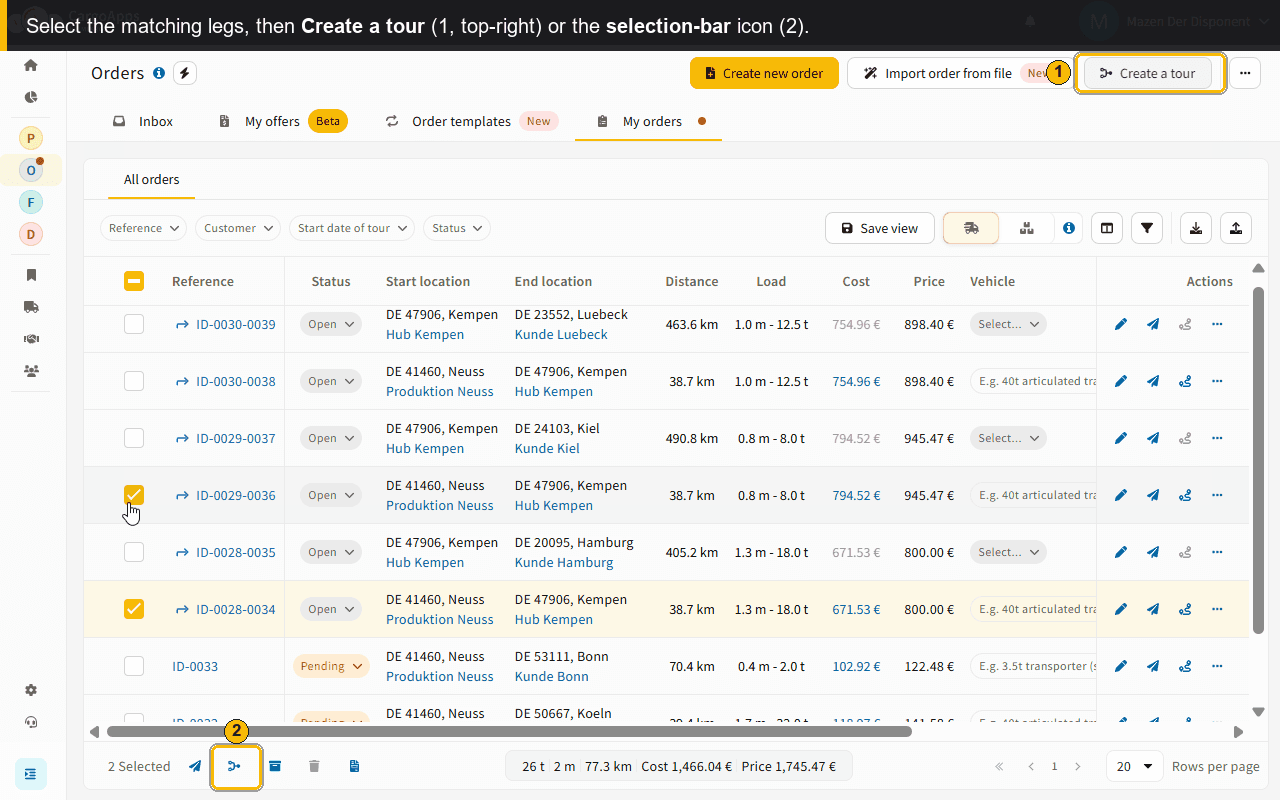
Step 1: Select the orders and click Create a tour.   
Select at least two Original Orders (you can filter by region, date, customer, or status first). Then click Create a tour in the top-right corner, or the tour icon in the selection bar. Finished orders cannot be included.

Select multiple orders and click Create a tour
Select the orders that belong together, then create the tour


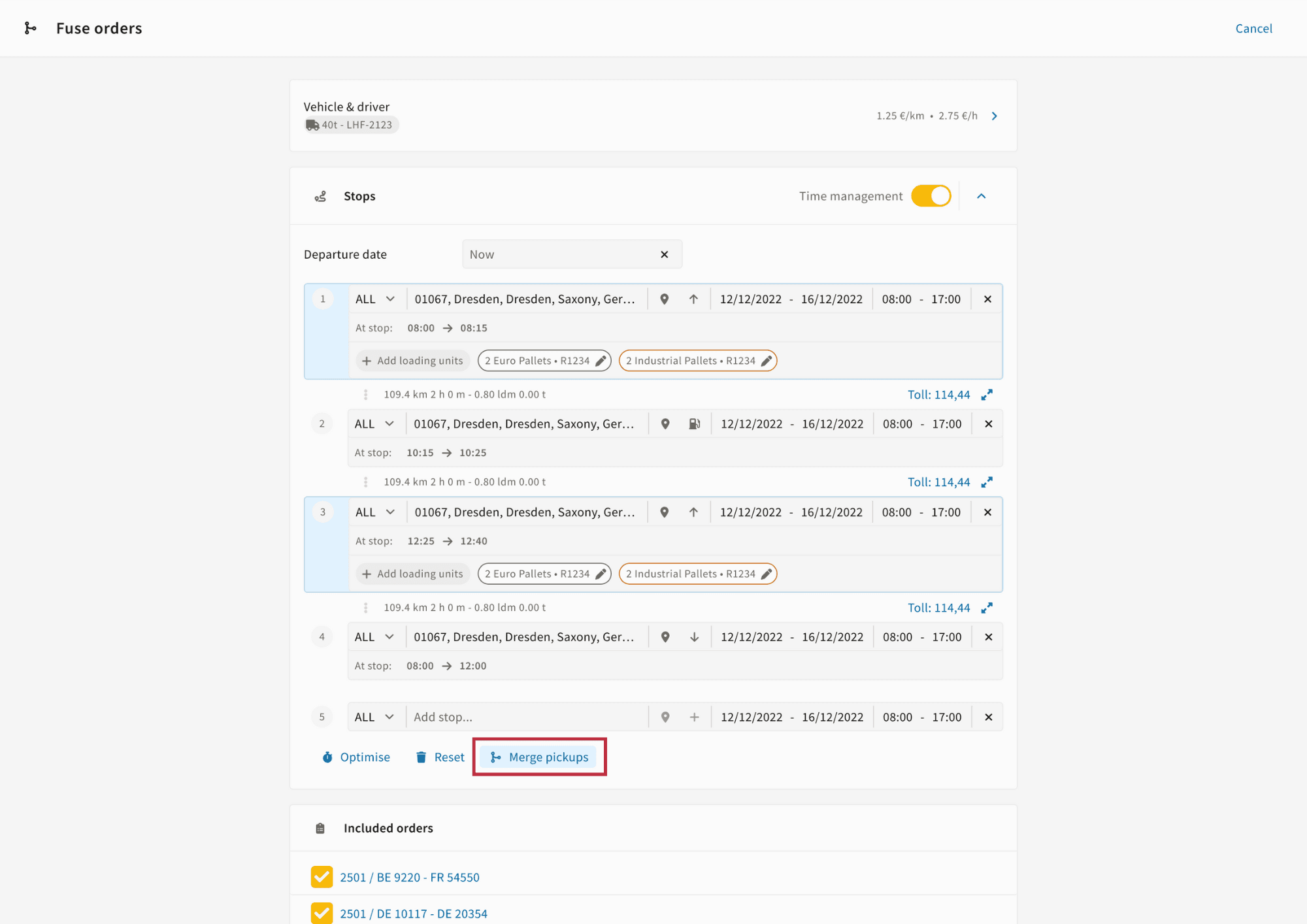
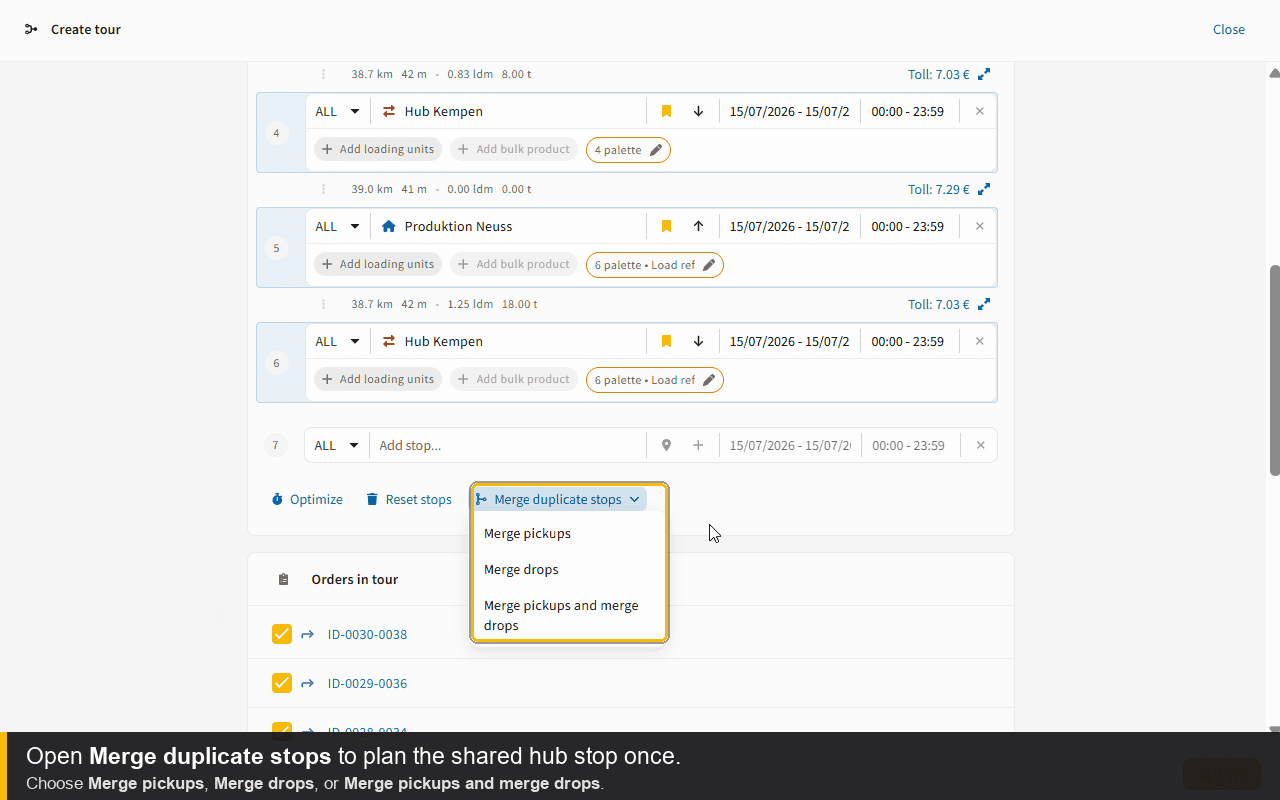
Step 2: Merge duplicate stops.   
When orders share the same pickup or delivery location, open Merge duplicate stops and choose Merge pickups, Merge drops, or Merge pickups and merge drops, so the shared stop is planned once.

Merge duplicate stops options when creating a tour
Merge duplicate stops so a shared stop is planned once


Stops only merge when the address, stop activity, and time window all match. Parking and refueling stops are never merged.

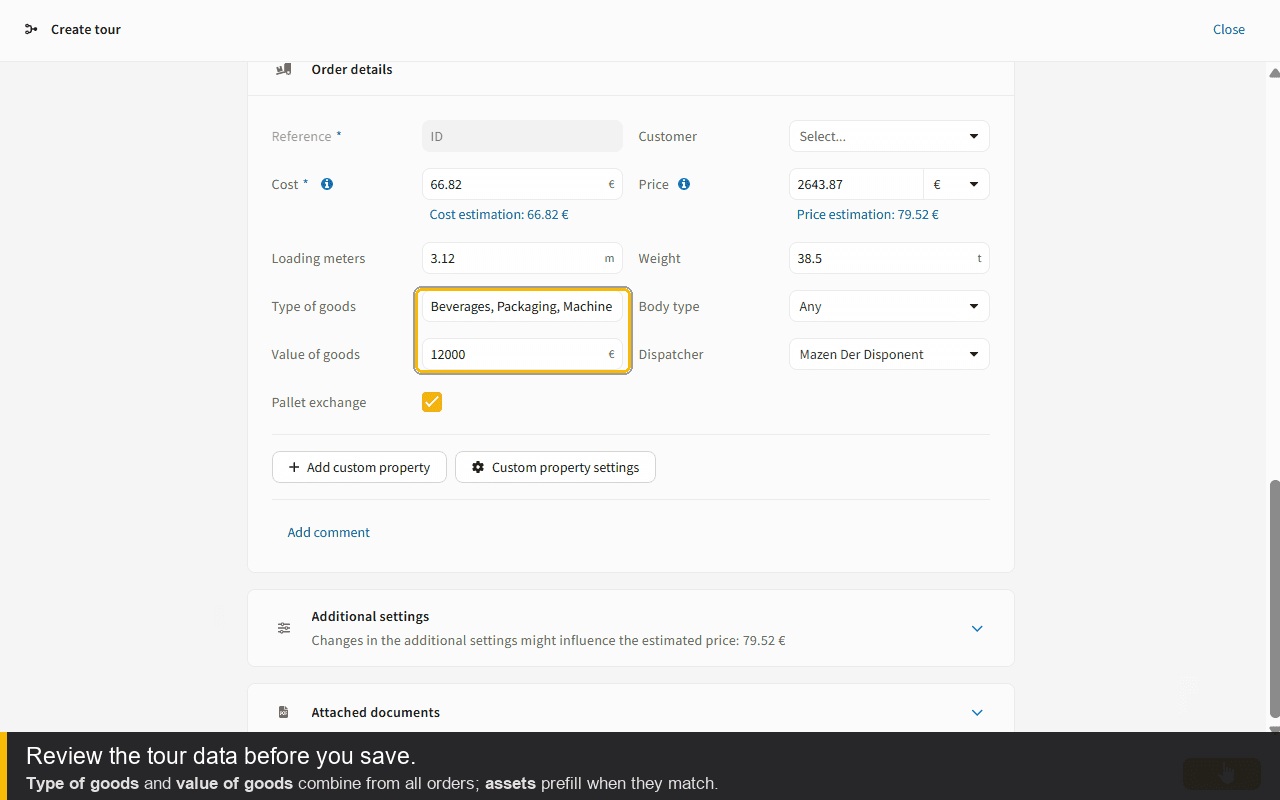
Step 3: Assign assets and review the tour data.   
The system pre-fills the vehicle, trailer, and driver when they match across orders (each asset type is checked independently; conflicts leave the field empty). Order data is combined: type of goods and value of goods aggregate, price sums, weight and loading meters take the maximum, and pallet exchange is checked if any order has it. Review everything before saving.

Review the tour data and included orders before saving
Review the tour data before saving


Note: Assigning an asset at the Tour level applies to all orders in the tour. If DriverApp was linked to one driver, it is assigned to the whole Tour. Edits made in the Tour do not sync back to the individual orders.

Step 4: Save the Tour.   
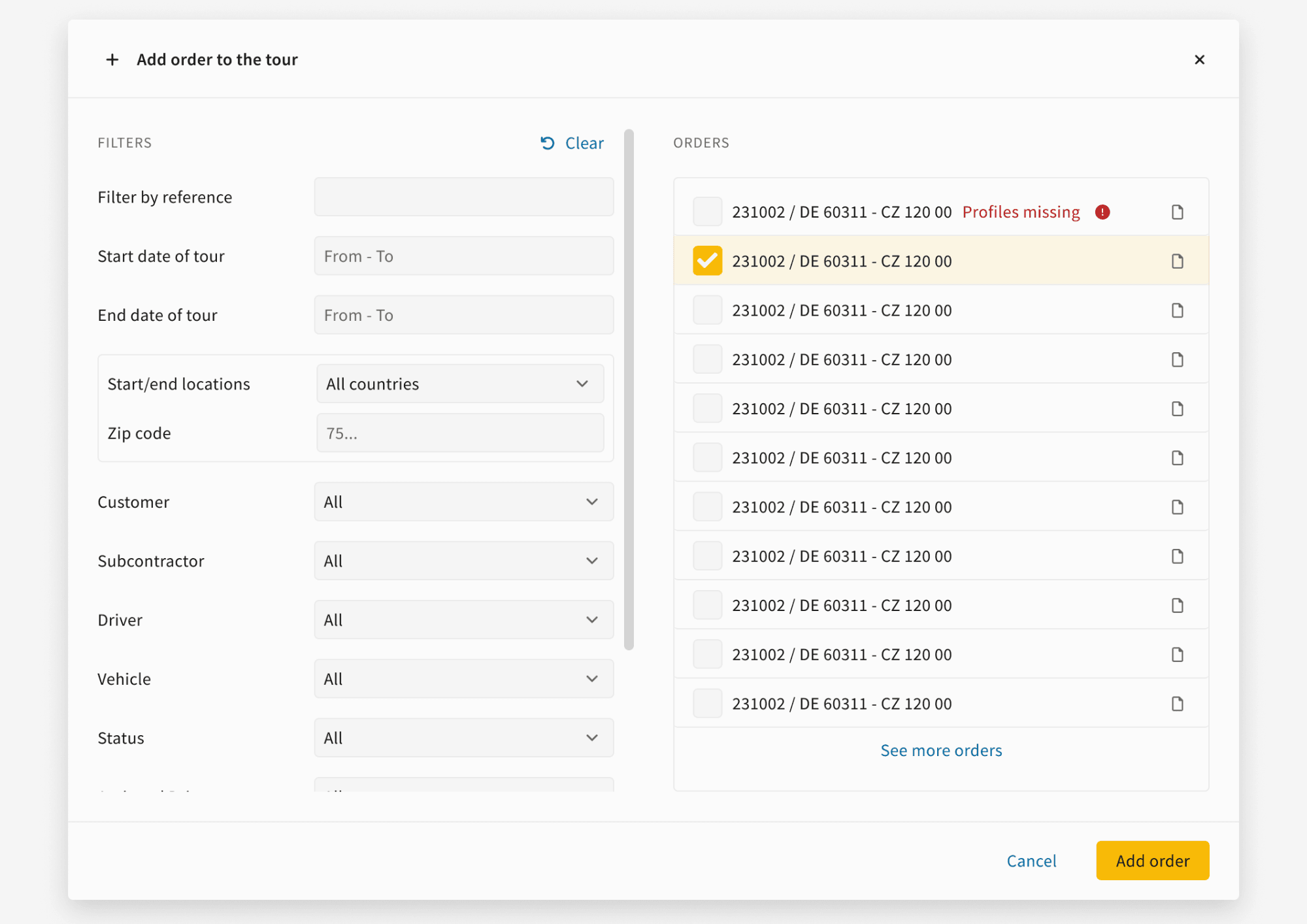
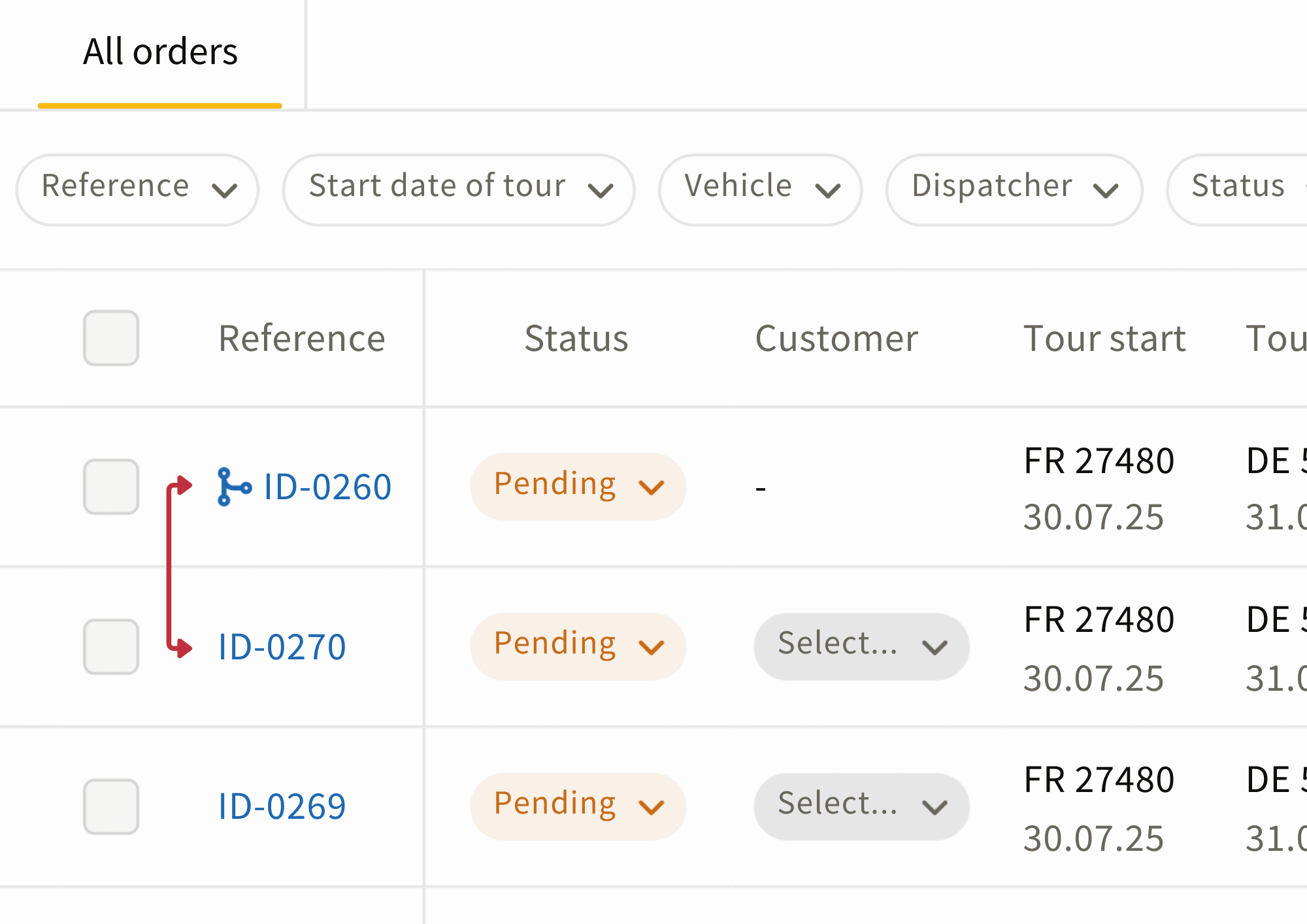
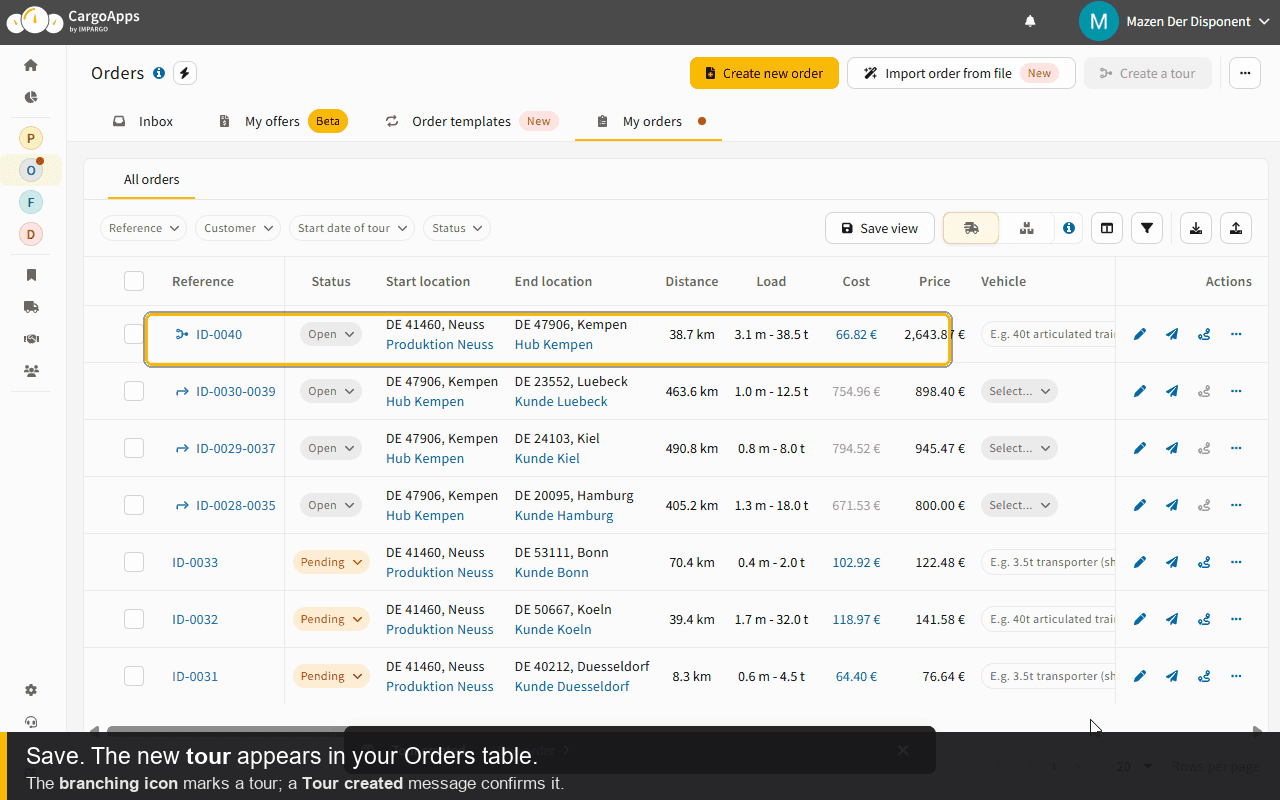
Reorder stops and add more orders if needed, then save. Stops cannot be deleted directly (remove the whole order instead). The new tour appears in the Orders table with its own branching icon.

The tour icon distinguishes a tour from normal orders in the table
Save. The new tour appears in your Orders table with its own icon


Step 5: Review the orders in the tour.   
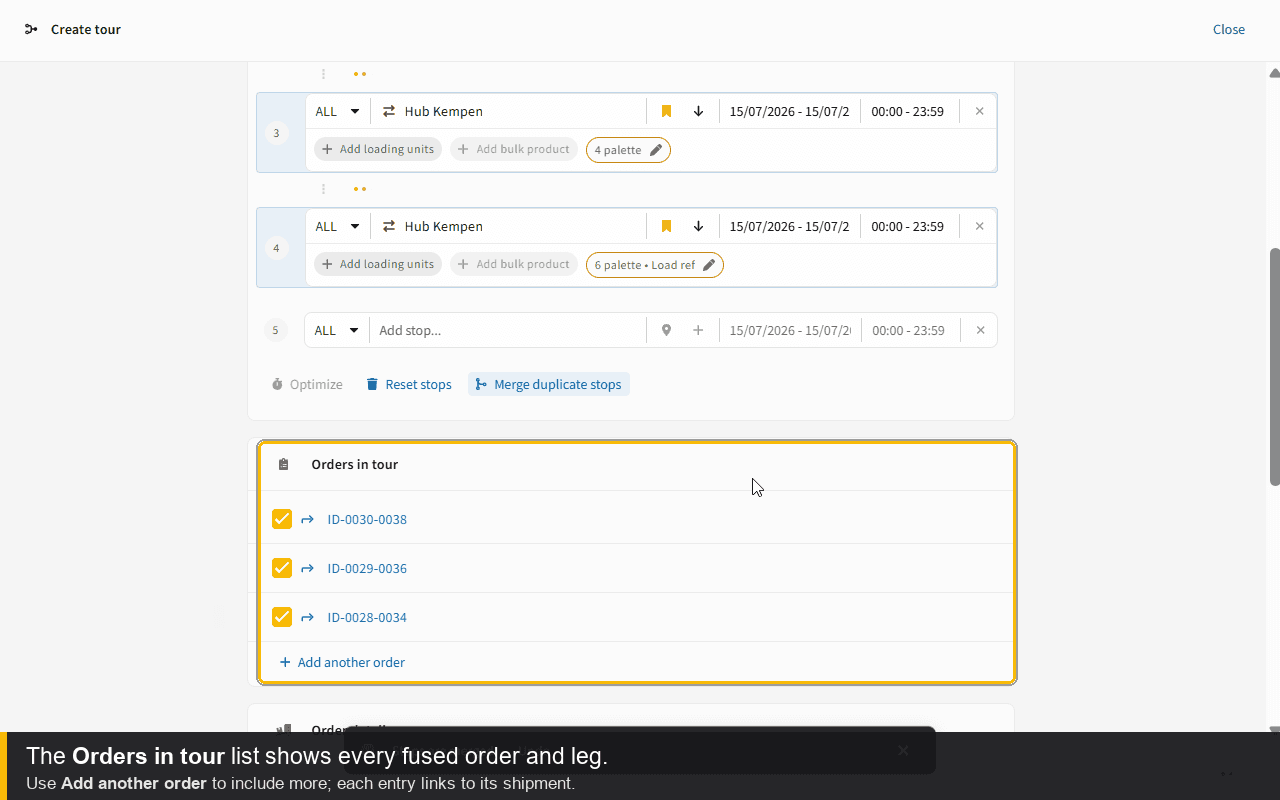
Open the tour and check the Orders in tour list. It shows every order fused into the tour; each entry links back to its shipment. Use Add another order to include more.

Review the orders included in the tour
The Orders in tour list shows every fused order


Tip: After you create a tour, optimize its route, by stop sequence or as a round trip, with the Optimize button. See How to Plan a Truck Route for the sequence and round-trip options.


3. Hub Handover: Split Orders, Then Fuse the Legs

Many carriers do not drive from pickup to delivery directly. Instead, they run several orders to a hub (a consolidation facility), and a second vehicle or partner handles the onward delivery.

Use Case
You have three orders from a production site in Neuss to customers in Hamburg, Kiel, and Lübeck. You drive all three to a hub in Kempen first, then a partner delivers onward. You split each order at Kempen, then fuse the three "Neuss to Kempen" legs into one pickup tour.

The workflow has two halves. First you split each order at the hub, then you fuse the matching legs into tours. The steps mirror Section 2, but the screenshots below deliberately show split legs being fused, so you can tell this apart from the whole-order flow above.

Step 1: Split each order at the hub.   
Open each order's three-dot menu, choose Split, and enter the hub as the swap location. Each order becomes a run to the hub and a run from the hub, and the original order keeps a Split orders tab listing Split leg 1 and Split leg 2. For the full split walkthrough (splitting at the hub, the Split orders tab, billing), see Execute Relay Trucking via Swap Points.

Step 2: Select the matching legs and click Create a tour.   
In the Orders table, select the legs that share the same route, for example all "Neuss to Kempen" legs. Legs are selected and fused exactly like whole orders, so click Create a tour.

Select the split legs that share a route and click Create a tour
Select the split legs that share a route, then create the tour


Step 3: Merge the shared hub stop.   
Because every pickup leg meets at the same hub, open Merge duplicate stops and merge the hub so it is planned once for the whole tour.

Merge the shared hub stop when fusing split legs
Merge the shared hub stop so it is planned once


Step 4: Review the tour data and save.   
The tour combines the legs' data (goods, price, weight) and prefills matching assets. Review it and save. The pickup tour then appears in the Orders table with the branching icon.

Review the combined leg data before saving the tour
Review the combined leg data before saving


The new leg-based tour appears in the Orders table
The new leg-based pickup tour appears in your Orders table


Step 5: Check the legs in the tour, then repeat for the delivery legs.   
Open the tour's Orders in tour tab to confirm the fused pickup legs, then fuse the delivery legs into a second tour for the partner.

Orders in tour tab showing the fused split legs
The Orders in tour tab confirms the legs in the pickup tour


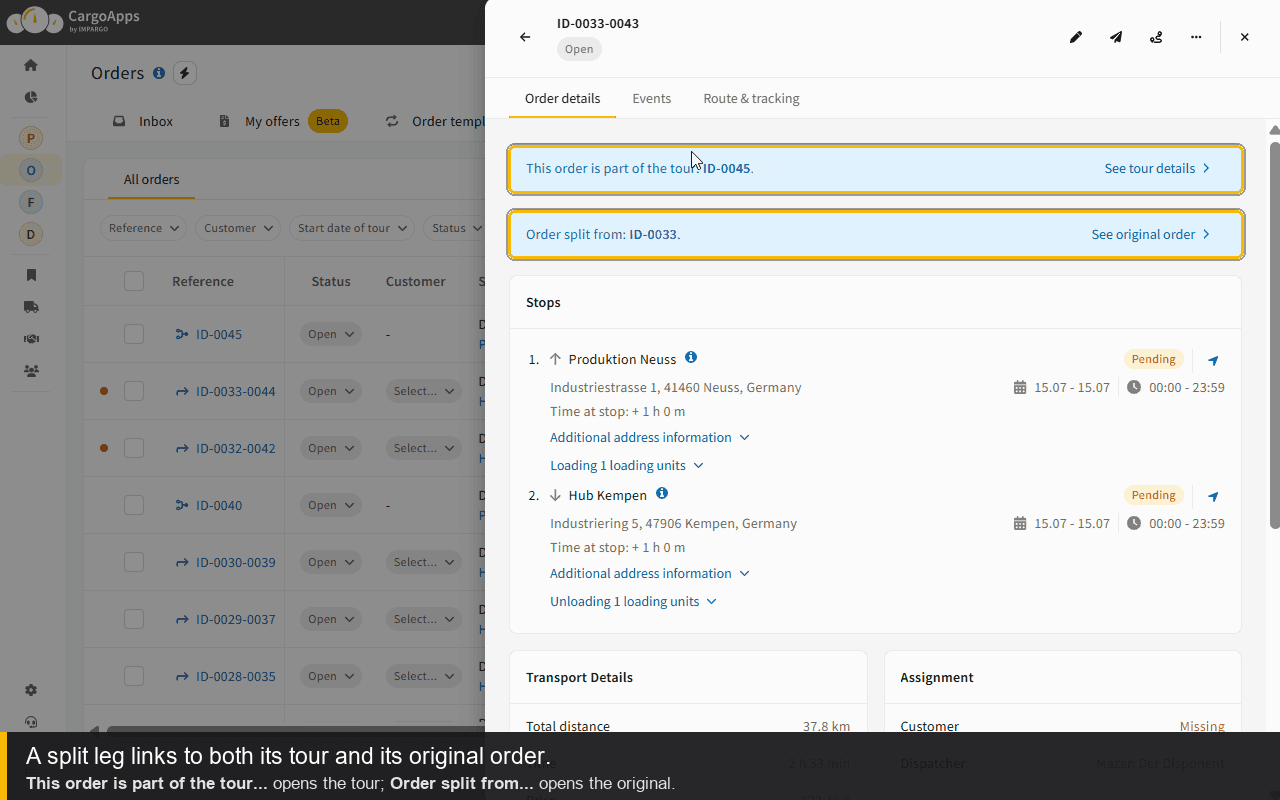
After fusing, each split leg keeps two links, so you can move between the tour that executes it and the original shipment it belongs to:

A split leg links to both its tour and its original order
"This order is part of the tour..." opens the tour; "Order split from..." opens the original


4. Monitor Tour Status & Events

When a driver executes a Tour, the system keeps the Tour, its orders in tour, and any parent split orders in sync. This gives dispatchers and customer service a complete, consistent view of statuses, events, and documents across the full transport chain.

  • Status: When a stop is completed in the Tour, the same stop is marked completed in each related order, and for split legs, in the parent split order.
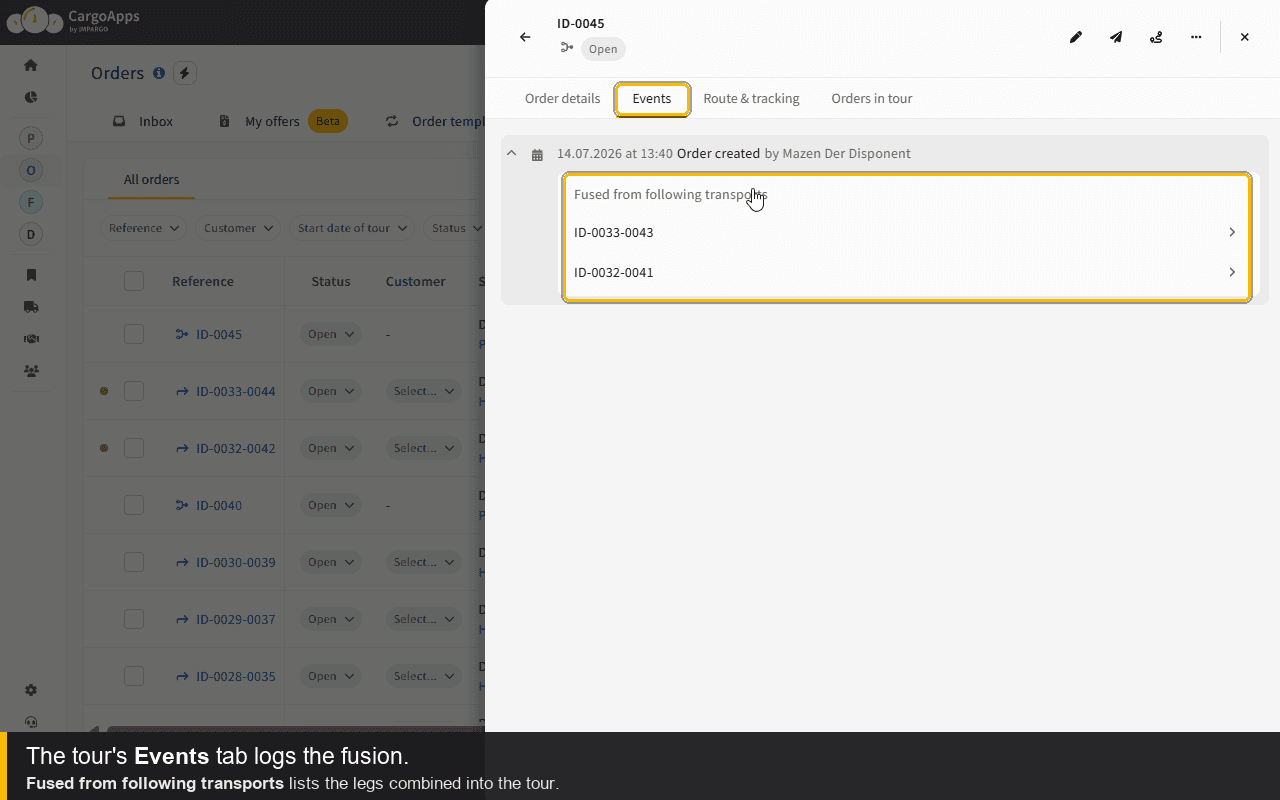
  • Events: The tour's Events tab logs the fusion. Fused from following transports lists the orders and split legs combined into the tour.
  • Attachments and PODs: A document or Proof of Delivery uploaded at a stop is added to the Tour and to the corresponding orders in the tour.


Tour Events tab showing Fused from following transports
The tour's Events tab logs the fusion


Important: Statuses, events, and documents sync across the Tour, the orders in the tour, and their parent split orders, avoiding duplication and keeping all stakeholders aligned.


5. Unfuse / Delete a Tour

If needed, you can revert a Tour back into its individual orders and legs.

Method 1: Delete the Tour.   
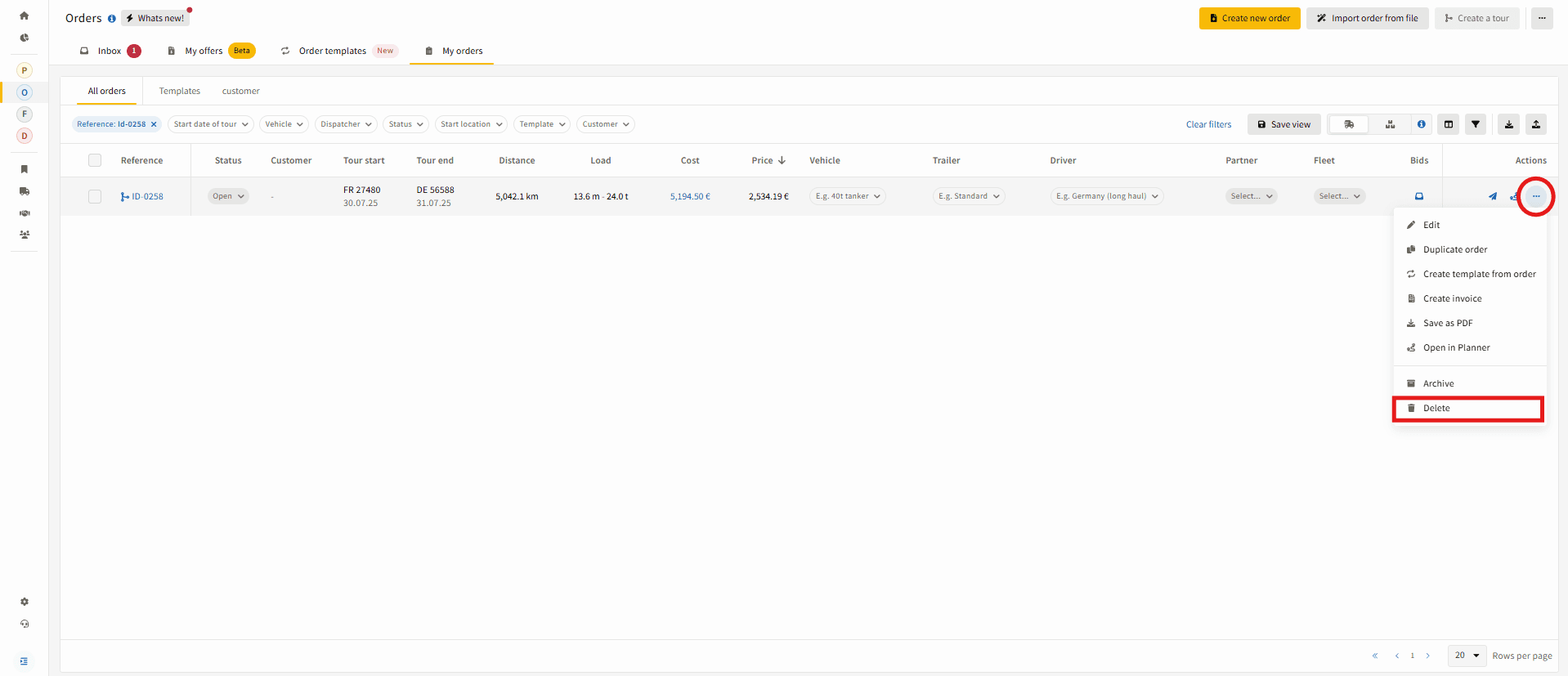
Find the Tour in the Orders table, click the three-dot menu (…), and choose to modify/delete. This restores all individual orders and split legs.

Delete a truck tour from the Orders module


Method 2: Remove the orders from the tour.   
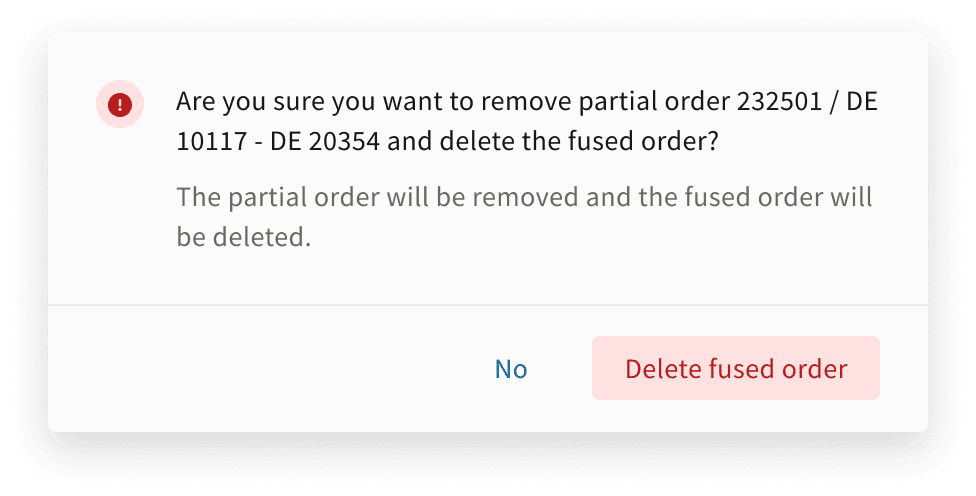
In the Tour creation modal, uncheck all orders in the tour and save. The system removes the Tour and restores the individual orders. Edits made in the Tour (comments, loading units, cost fields) are not carried back.

Warning when removing orders from a tour
Warning pop-up when removing orders from a tour


Troubleshooting: Cannot Delete or Unfuse a Tour

This usually happens when the Tour already has the status Ended, Invoice Created, or Paid. When a Tour is finished or invoiced, it becomes locked to protect completed transports.

If the Tour is still assigned to a driver, change its status to Pending in the Orders table, open the Fleet module (the Tour appears under Next Orders), unassign it from the driver, then delete the Tour from the Orders table. If the Tour is not assigned to a driver, reset its status to Pending and delete it directly.


6. Export a Tour as PDF

You can export a Tour with all its orders for documentation and communication.

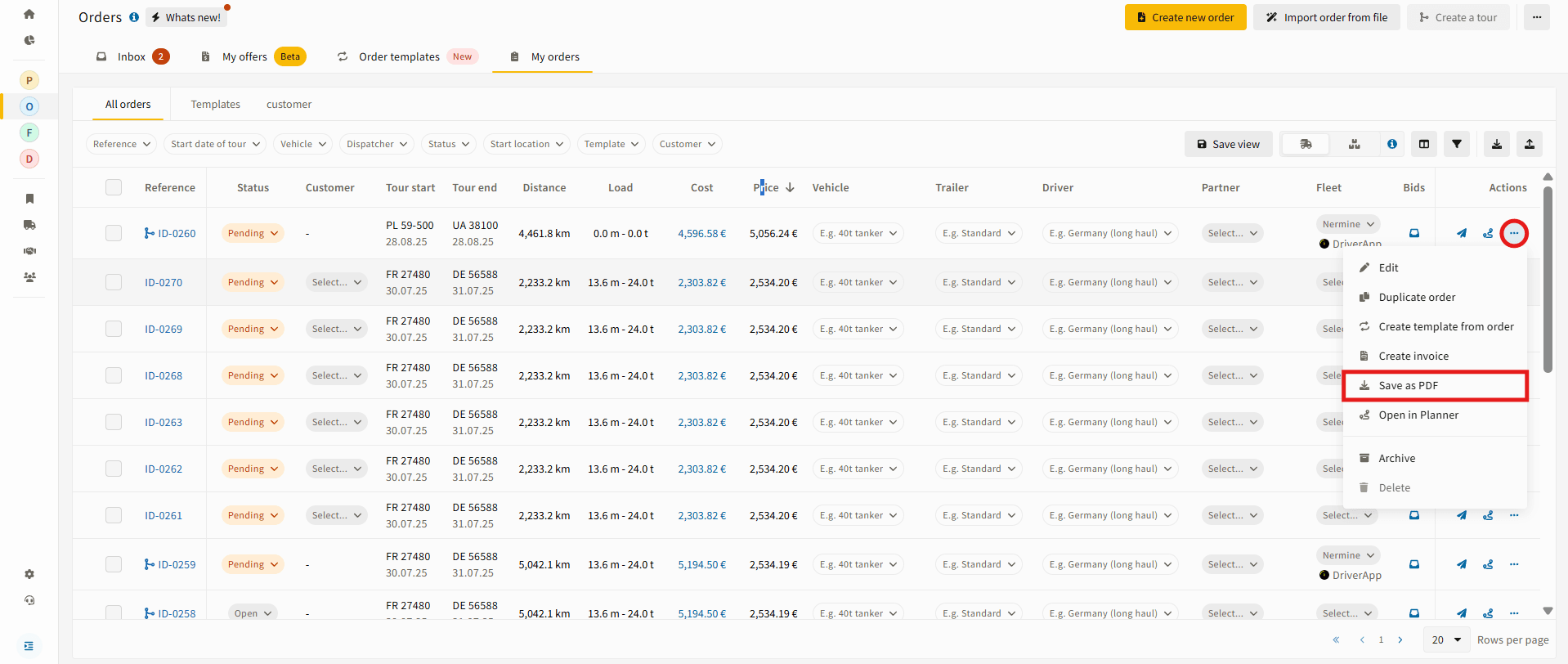
Step 1: Export the Tour.   
Find the Tour and choose Save as PDF.

Export a truck transport tour as PDF
 

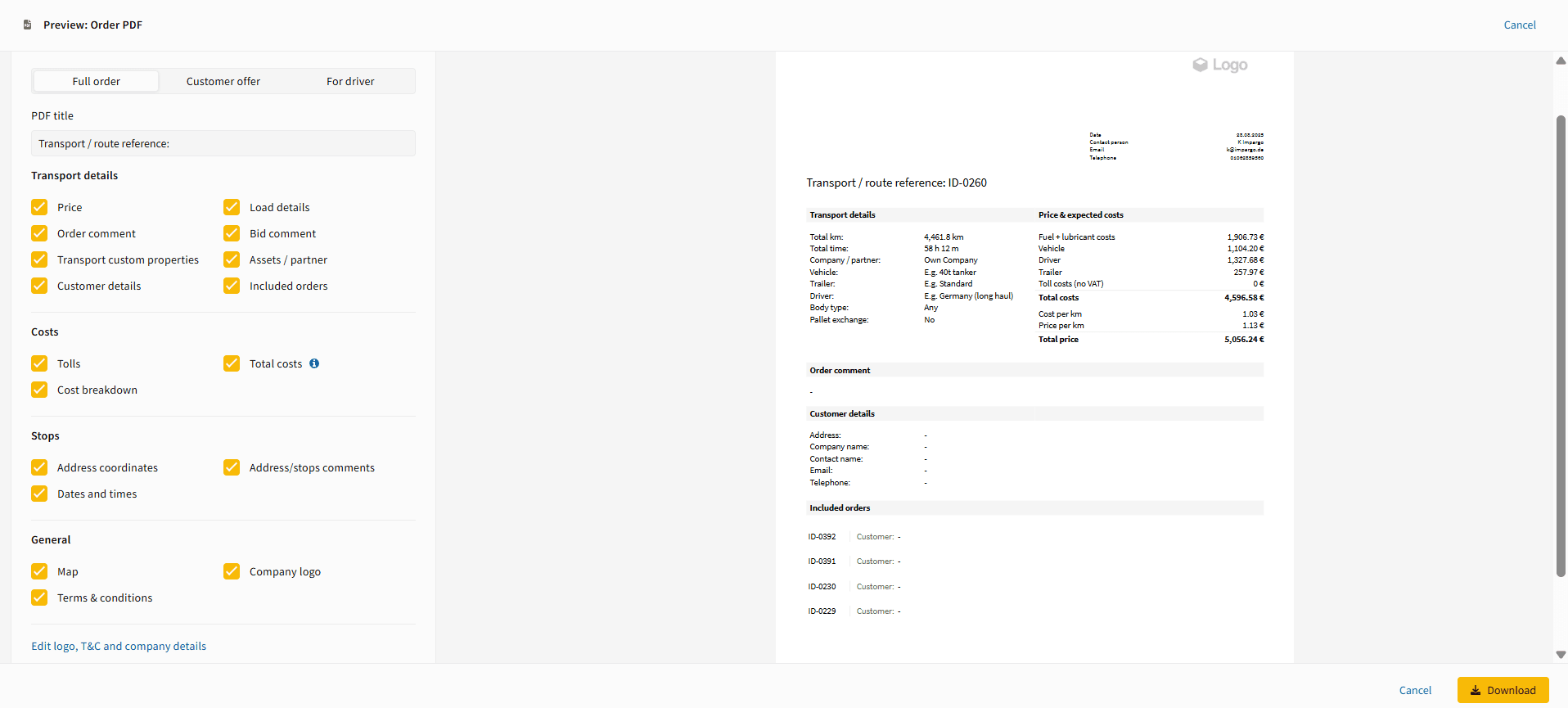
Step 2: Review the included orders.   
The export lists all orders in the tour with their reference numbers and customer names.

Step 3: Apply custom properties.   
Optionally include custom properties in the export.

View a truck transport tour as PDF
PDF export of a Tour with its included orders


7. Find Tours Across Views

Use the toggle above the Orders table to switch views, and read the reference icon to tell each order type apart.

Transports (Execution view) shows tours and standalone legs, ready for dispatch. A branching icon marks a tour; an arrow icon marks a split leg or an order in a tour.

Transports Execution view showing tours and split legs
Transports (Execution view) shows tours and legs


Shipments (Documentation view) always shows the original orders (for invoicing and overview), even when they are fused into a tour. A split order carries a split icon; an untouched original order has no icon.

Shipments Documentation view showing the original orders
Shipments (Documentation view) shows the original orders


8. Review Important Rules

Rules for creating and managing Tours

  • At least two orders are required to create a Tour
  • You can fuse Original Orders, split legs, or a mix of both
  • Finished orders cannot be fused
  • An order can be split into two legs at a single hub only; multi-stop splits and multiple hubs are not supported
  • Duplicate stops only merge if the address, stop activity, and time window all match
  • Parking and refueling stops are never merged
  • Stops cannot be deleted directly. Remove the entire order from the tour instead
  • Assets only prefill if all orders share the same value; conflicts leave fields empty
  • Edits in a Tour do not sync back to the orders in the tour


The following always sync automatically:

  • Status updates
  • Stop completions
  • Events
  • Attachments and PODs


Plan hub handovers with less manual work
See how IMPARGO TMS turns split orders into efficient tours, trusted by over 20,000 dispatchers across the EU.
Book a demo  Open the Orders module

Import Transport Orders From PDF with AI

Execute Relay Trucking via Swap Points


Impargo-logo

Digitalize your transport business overnight.

© IMPARGO 2026, All rights reserved.