Discover how to optimize billing in your transport business using the IMPARGO Order Management System. Our platform offers robust features for automation, which minimizes manual input and errors, and customization, allowing invoices to be tailored to specific business operations. Seamless integration with existing billing systems ensures a smooth automated data flow, enhancing efficiency. This guide will lead you through the steps from initial software integration to post-creation invoice management, ensuring a streamlined billing process that aligns with your operational needs.
1. General Overview
Integrate your invoicing and accounting systems digitally with IMPARGO to automate your entire invoice creation process. This integration facilitates seamless, efficient management of financial tasks, and includes:
Automatic invoice generation
Synchronization of customer and address data
Transfer of detailed order specifics (prices, load specifics, stops)
Proof-of-delivery transfers
Options for single or bulk invoice creation for multiple orders
Single Invoices: Suitable for businesses handling distinct shipments, each warranting separate billing and detailed tracking.
Collective/Bulk Invoices: Optimized for regular, smaller orders, allowing consolidation into fewer invoices to streamline payments and reduce administrative costs. All orders in a bulk invoice must use the same price currency.
Multi-Currency Compatibility:
SevDesk: supports invoices in foreign currencies, so the order's price and currency are transferred to the invoice.
Lexware Office (formerly lexoffice): currently supports euro invoices only.
SmartBill (Romania): supports invoices in foreign currencies, so the order's price and currency are transferred to the invoice.
⚠ Warning
If the connected billing tool does not support multi-currency, invoices can only be created in euros.
Access and Pricing:
Required: IMPARGO business plan and a subscription to the billing software.
Note: Standard integrations like SevDesk, Lexware Office, and SmartBill include no additional charges. Custom integrations may incur setup fees.
The setup process depends on your chosen billing software. Here's how to integrate with Lexware Office, SevDesk, and SmartBill:
Setting up Lexware Office integration
Lexware Office (formerly lexoffice) is a German accounting and invoicing tool. Multi-currency: not supported. Invoices created through this integration are issued in euros only.
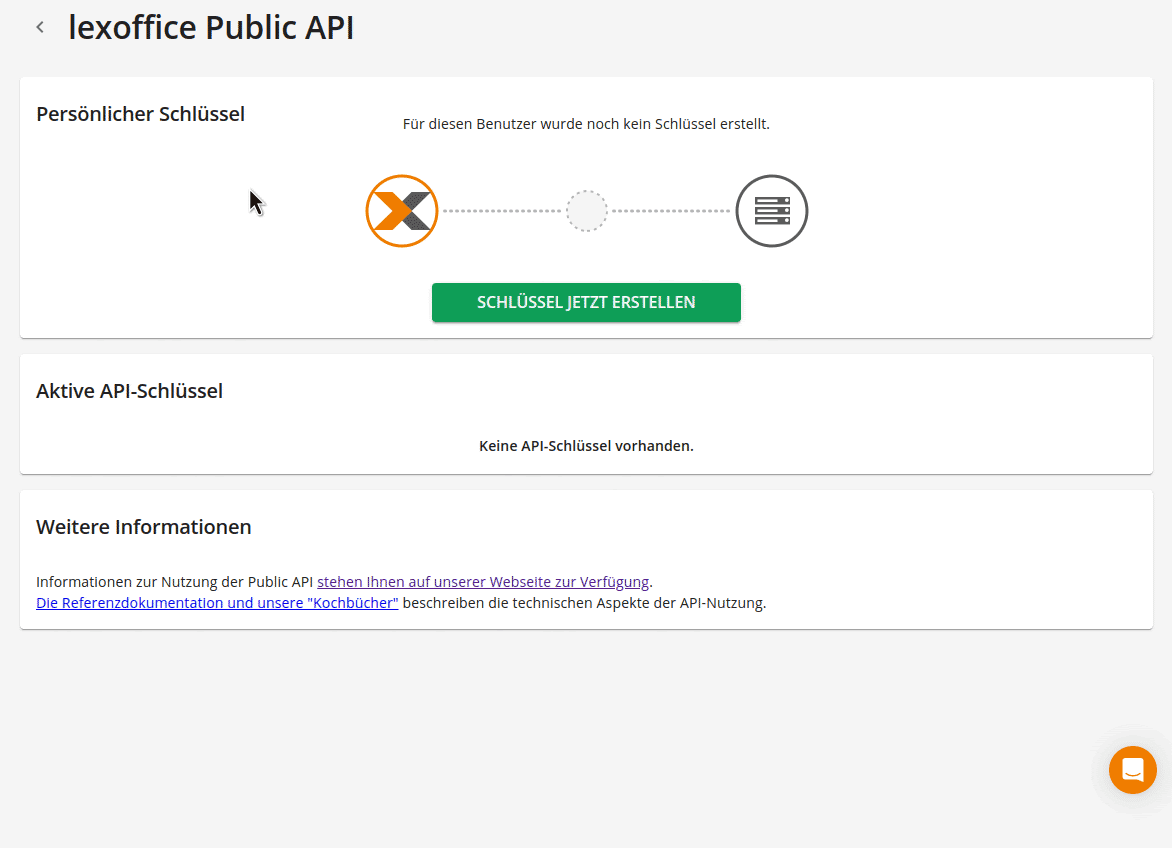
Step 1: Open the Lexware Office public API. Log in to your Lexware Office account and open the Lexware Office API add-on.
Step 2: Create an API key. Generate a new key for the IMPARGO integration.
Step 3: Share the key with IMPARGO. Send the key to the IMPARGO customer service team, who complete the connection on your account.
Setting up SevDesk integration
SevDesk is a German accounting and invoicing tool. Multi-currency: supported. SevDesk handles invoices in foreign currencies, so the order's price currency is carried over to the invoice (see how multi-currency support works).
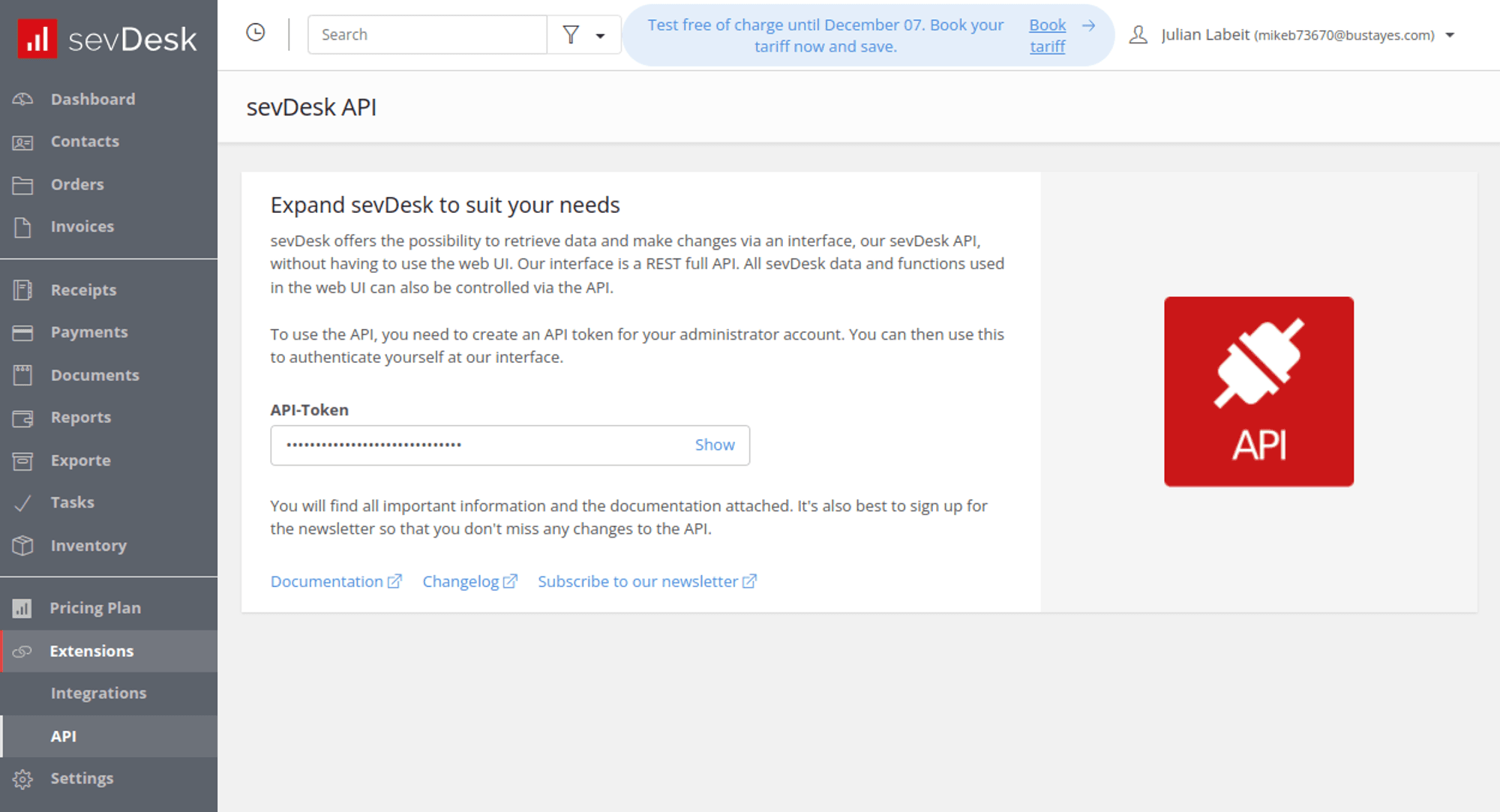
Step 1: Open the SevDesk API settings. Log in to SevDesk and open the SevDesk API page.
Step 2: Create an API token. Generate a new API token for the IMPARGO integration.
Step 3: Send the token to IMPARGO. Share the token with the IMPARGO customer service team, who complete the connection.
Setting up SmartBill integration
SmartBill is a Romanian invoicing platform. Multi-currency: supported. SmartBill handles invoices in foreign currencies, so the order's price currency is carried over to the invoice (see how multi-currency support works).
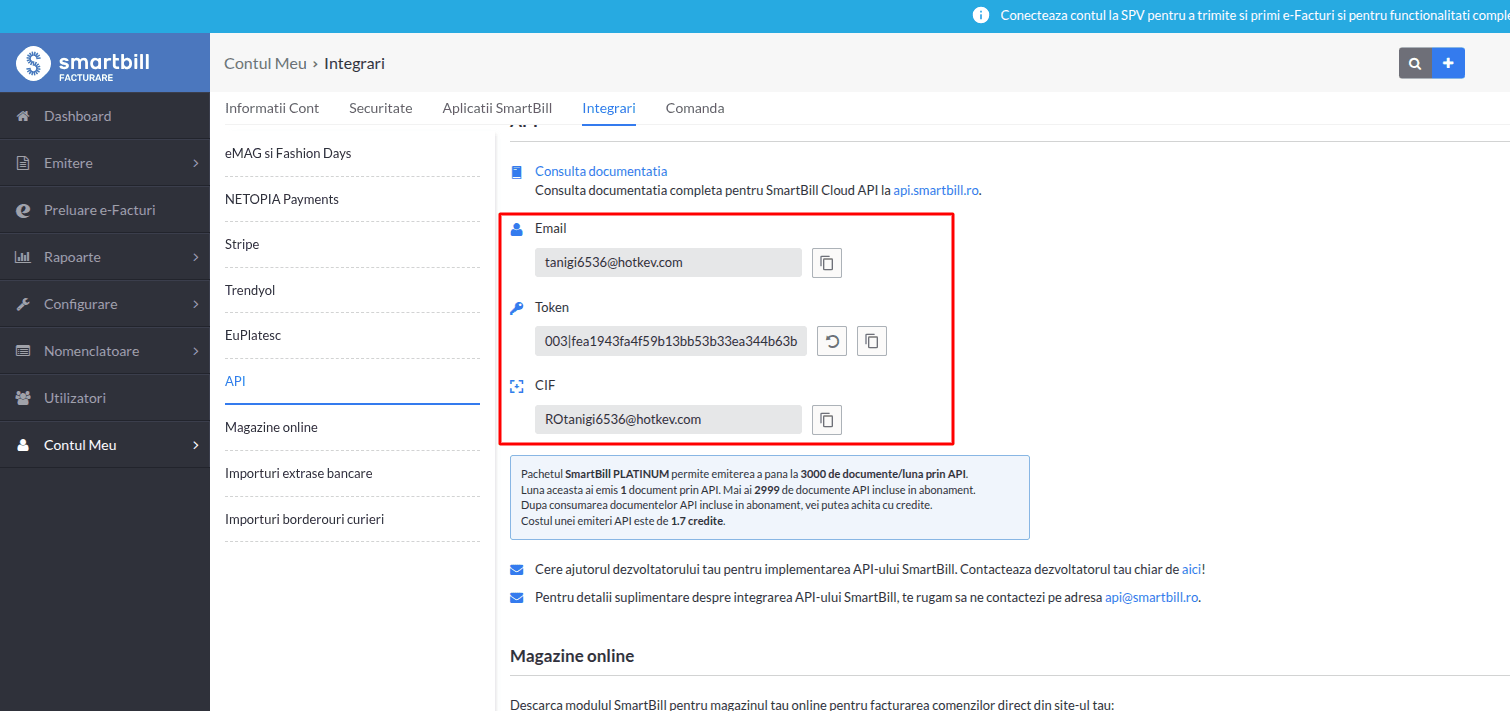
Step 1: Open the SmartBill integrations page. Log in to SmartBill and open the SmartBill integrations page, then go to the API section.
Step 2: Copy your API credentials. In the API section, copy the following values:
Email
Token
CIF
Step 3: Share the credentials with IMPARGO. Send the Email, Token and CIF to the IMPARGO customer service team, who complete the connection.
Important differences with the SmartBill integration:
Multi-currency: supported. Invoices are created in the order's price currency (see how multi-currency support works). For reference, SevDesk also supports foreign currencies, while Lexware Office issues euro invoices only.
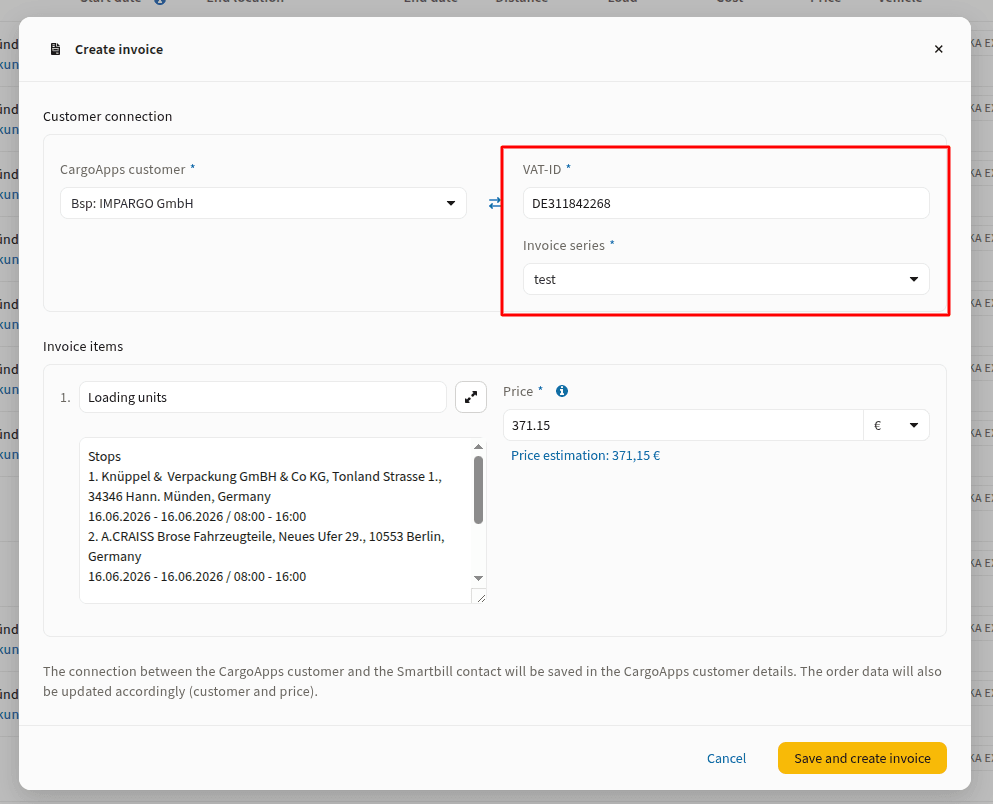
Invoice series: in Romania every invoice must carry a series (a short prefix, for example "IMP") followed by a sequential number. SmartBill can hold several series at once, for example one per activity, location, or agent. You set these up in SmartBill, then choose which series to use when you create the invoice in IMPARGO (see screenshot below). If you keep a single series, it is applied by default.
Required data: an invoice can only be created in SmartBill when every mandatory field is present in IMPARGO: the customer's name, address and VAT-ID (CIF/CUI in Romania), the order price and currency, and a selected invoice series. If any of these is missing, IMPARGO blocks the invoice until you complete the record. You add and edit these details on the customer record (see how to manage customers) and when creating the invoice from the order (see how to create an invoice).
No separate customer management (the VAT-ID is the reference): unlike Lexware Office and SevDesk, there is no external customer list to link to, and IMPARGO does not store a separate SmartBill customer reference number. Instead the VAT-ID on the CargoApps customer identifies the client to SmartBill, and IMPARGO sends the full customer data (name, address, VAT-ID) with every invoice. Keep the VAT-ID accurate on the customer record (see how to manage customers). See also how customer data is handled when creating an invoice.
3. Customize Integration
Customization is available in two primary forms:
System Integration: Connect your existing systems that are not yet integrated. Ask us and we will provide you an offer to integrate your current systems.
Invoice Customization: Modify the elements of an invoice. This includes the addition or removal of data. For instance, you may add custom fields to invoice positions, such as an "Invoice Note," or define specific "unit names" used for invoicing (the default unit is "1 x Transportation").