Calculate Truck Toll Automatically Across Europe
Updated May 2026
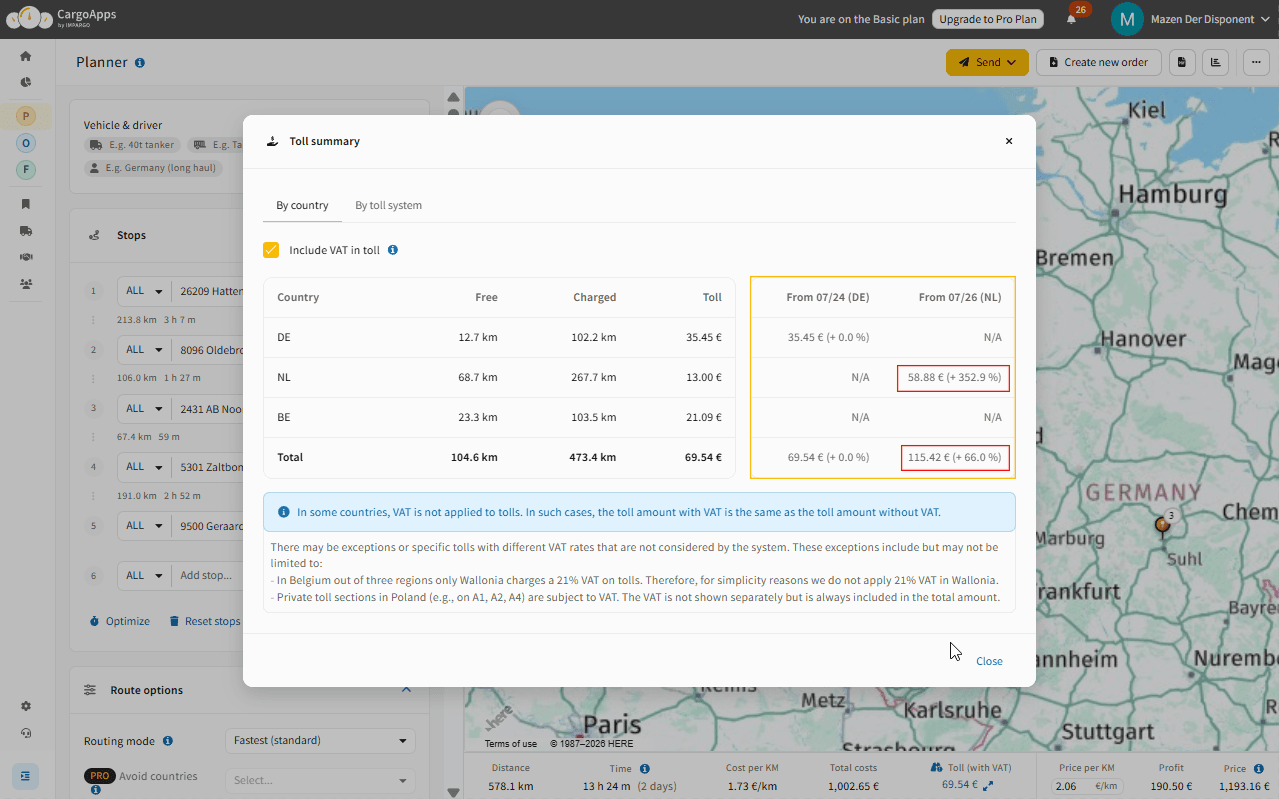
Calculating truck toll in Europe used to be a spreadsheet job. In 2026 it isn't. Germany switched to a four-component rate in December 2023 and expanded the toll to vehicles from 3.5 t in July 2024. Austria reformed its tariff structure on 1 January 2026 with a 10–13 % effective increase driven by CO₂ and external-cost components. The Netherlands abolishes the Eurovignette and introduces a per-kilometre Vrachtwagenheffing on 1 July 2026 for every N2/N3 truck above 3.5 t. France has converted the A13/A14 Paris–Normandy corridor to barrier-less Free Flow.
A single cross-border tour can now touch four or five different toll regimes — each with its own input set, its own CO₂ logic, and its own billing model. Manual calculation in 2026 produces a number that's either too low (margin disappears) or too high (you lose the quote). This guide explains what an automatic toll calculator actually has to handle, country by country, so that quoted price matches invoiced cost.
What "automatic toll calculation" means in 2026
Automatic toll calculation is software that reads a route and a vehicle profile, looks up the current rate table for every tolled segment along the way, and returns a per-kilometre cost broken down by country. That used to be a thin wrapper around a per-km flat rate. After the Dec 2023 German CO₂ reform and the parallel reforms in Austria, Hungary and Poland it isn't. The calculator now needs to maintain a live table of per-country, per-weight-class, per-axle-count, per-Euro-class, per-CO₂-class rates — about 600 unique rate cells for the seven most-used corridors alone — and re-derive your CO₂ class as Toll Collect tightens its reference values 2.5 % per year through 2026 and 3 % per year from 2027.
What this means in practice: a calculator built before December 2023 returns a number that ignores the largest single component of the German toll. A calculator that hardcodes Austria's 2024 rate table is now 10–13 % wrong on every Austrian segment. A calculator that doesn't know the Netherlands introduces Vrachtwagenheffing on 1 July 2026 will quietly stop matching the invoice from that date forward. Accuracy depends on whether the calculator's rate engine is maintained, not on whether the tool exists.
Why manual calculation no longer works
Three structural changes in the last 30 months made manual toll calc unworkable for any operator running more than a handful of cross-border tours. Each one alone is manageable; in combination they exceed what a dispatcher can do quickly enough to quote a customer:
The combined effect: even if a dispatcher gets the per-km rate right, they're likely to get the CO₂ class wrong on a German leg, the axle category wrong on a French one, and the VAT treatment wrong on the cross-border combination. The error stacks. On a typical Rotterdam–Milan tour the gap between a manually-calculated quote and the invoiced cost can easily reach €80–150.
Country by country: what an accurate calculator must handle
The 15 countries below cover roughly 95 % of European HGV tolled kilometres. The column "What the calculator must know" lists the inputs the rate engine genuinely needs to return an accurate per-km cost — not what's nice to have. If a calculator doesn't accept those inputs, the number it returns is an approximation, not a calculation.
The third column shows why "a per-km estimate" isn't enough. Two trucks doing the same Berlin–Vienna run can pay 15 % different tolls based on Euro and CO₂ class alone. A 40 t articulated truck in Euro 6 CO₂ class 1 pays 34.8 ct/km on German federal roads; the same truck in CO₂ class 4 pays 26.9 ct/km. That 7.9 ct gap, applied across 100,000 km a year, is €7,900 per truck — money that's on the table when the calculator knows about the CO₂ re-classification path and lost when it doesn't.
The 8 inputs every accurate toll calculator needs
If a toll calculator doesn't ask for the following eight inputs (or read them from the vehicle profile), the price it returns is a guess, not a calculation. The list below is the minimum set; anything less and at least one country's rate will be wrong.
- Technically permissible gross mass (tzGm / F.1). Since December 2023 in Germany this is the value that decides the weight class, not the older field F.2. Many trucks moved up a class overnight when the rule changed.
- Axle count, including lift axles. Lift axles count whether raised or lowered. Tandem axles count as two. For combinations, the trailer's axles add to the tractor's.
- Euro pollution class. Euro 0/1 through Euro 6. Drives the air-pollution component in DE, AT, HU, PL — and entire-rate tables in IT and FR.
- CO₂ emission class (1–5). Class 1 is the default (most expensive); class 5 is zero-emission. The class depends on the vehicle's reference CO₂ value vs. an annually tightening benchmark. Required for accurate German, Austrian, Hungarian and (from 1 July 2026) Dutch rates.
- Fuel type (diesel / gas / electric / hydrogen). Determines whether the zero-emission exemption applies and how long it runs in each country.
- Route start, end, and intermediate stops. Closed-system countries (FR/IT/ES/PT) bill by ticketed segment, not as-the-crow-flies distance. An intermediate stop that re-enters the network is a new ticket and a new toll.
- VAT treatment (gross / net toggle). Quotes go out gross; planning happens net; reclaim is on the gross figure. The calculator has to show both.
- Country-of-establishment of the operator. Determines which VAT reclaim regimes apply. A German operator running in Italy reclaims Italian IVA differently than an Italian operator running in Germany.
Net vs gross: VAT handling
This is the single most common error in homegrown toll calculations. Toll rates published by national operators are usually net (excluding VAT) for the German Maut, but the Italian, French, Austrian, Polish and Spanish tolls are published gross (including the country's VAT rate — 22 %, 20 %, 20 %, 23 %, 21 % respectively). Sum the two without normalising and you're comparing different things.
For an operator quoting a Hamburg–Milan tour to a customer, the right approach is: calculate everything gross for the quote (because that's what hits the invoice), but track everything net for margin (because most of the VAT is reclaimable). A calculator that doesn't separate the two forces the dispatcher to do the conversion manually for every country — and at four or five countries per tour, that's where errors creep in.
Specific reclaim notes: French tolls (TVA 20 %) are reclaimable through the 8th Directive procedure for EU-established operators; Italian tolls (IVA 22 %) via the same mechanism. Austrian tolls (USt 20 %) and Polish tolls (VAT 23 %) likewise. The German Maut is the outlier — it's a fee, not a VAT-bearing service, so there is no VAT to reclaim. A calculator that adds 19 % to the German number is wrong.
OBU billing vs EETS box billing
The toll itself is the same regardless of how it's billed. What changes is the invoice structure and how the calculation has to be reconciled. Two models exist:
National OBU billing. Each country's operator (Toll Collect, ASFINAG, Viapass, e-TOLL, HU-GO, Telepass) sends a separate monthly invoice. The invoices are accurate, but you reconcile each one against route data per country. For an operator running in 8–10 countries, that's 8–10 separate invoices to reconcile monthly.
EETS box billing. A single EETS provider (DKV, AS24, Eurowag, Telepass Europe, Toll4Europe) consolidates the toll across 12 or more countries onto one invoice. The Netherlands joins the EETS network from 1 July 2026 — Toll4Europe is already confirmed as the first EETS provider signed for the Vrachtwagenheffing. The EETS provider charges a service fee of typically €0.50 to €1 per chargeable day per country on top of the pass-through toll.
Either way, the per-km calculation that goes into the quote is the same. The difference shows up in cost-control: with national OBUs, the calculator has to reconcile against multiple invoice formats; with an EETS box, against one. For a calculator to be useful at quote stage it needs to predict the pass-through toll component accurately and let the operator add their own EETS service-fee assumption.
What to test before trusting a calculator
The fastest way to find out whether a toll calculator is actually maintained is to run three test cases that exercise the recent reforms. If the calculator gets all three right, the rate engine is up to date. If it gets any of them wrong, treat the numbers as indicative only.
Test 1 — German CO₂ class. Two identical Euro 6 articulated trucks (40 t, 5 axles), 100 km on German Autobahn. One in CO₂ class 1, one in CO₂ class 4. The class-1 truck should return €34.80 (100 × 34.8 ct). The class-4 truck should return €26.90. If both return the same number, the calculator hasn't implemented the CO₂ component — it's using a pre-Dec-2023 rate table.
Test 2 — Austrian 2026 rates. A Euro 6 CO₂ class 1 4+ axle truck on 100 km of Austrian motorway should return roughly €57.24 (the 2026 rate; ASFINAG published the 2026 schedule on 18 Dec 2025). A calculator that returns the 2024 or 2025 number on the same input is at least 10 % behind the live tariff.
Test 3 — Netherlands Vrachtwagenheffing date awareness. A 40 t Euro 6 truck on 100 km of Dutch motorway dated 1 June 2026 should return only the Eurovignette day-share (still under the old regime). The same query dated 1 July 2026 should return a per-km cost around €16 (the per-km Vrachtwagenheffing). A calculator that returns the same number on both dates either hasn't implemented the changeover yet, or has implemented it but ignores the date.
How IMPARGO calculates the toll inside the Planner Module
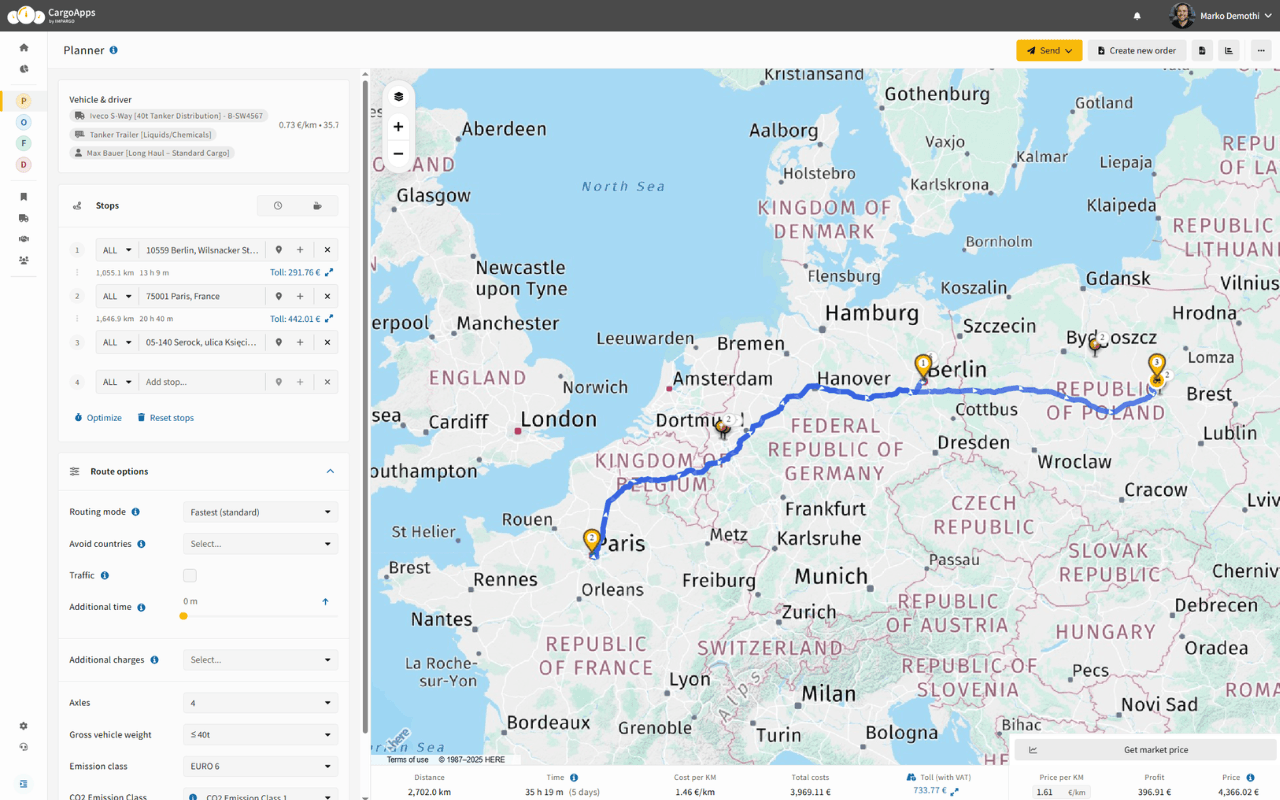
The Planner Module is IMPARGO's route-and-cost calculator. It runs the eight inputs from §4 against a maintained rate engine, returns per-country toll costs, and exposes both gross and net figures with a VAT toggle. Two design choices worth flagging because they're not standard:
Per-country breakdown, not a single total. The output shows what each country contributes — German Maut as one line, Austrian GO toll as another, French TIS PL as another, and so on. Dispatchers can verify each segment against the corresponding operator's invoice once the trip has run; finance can post each component to the right cost centre.
Side-by-side route comparison, not an auto-pick. Two route variants — say Brenner Pass vs Reschen Pass for a Munich–Milan run — sit next to each other with toll, distance and transit time visible. The Planner doesn't silently pick the cheaper one; the dispatcher does, with all three numbers in view, because the "right" route for a customer with a tight delivery window isn't always the cheapest one. The same applies to French autoroute alternatives, German Autobahn vs Bundesstraße shortcuts, and Austrian transit alternatives.
Routing itself accounts for axle load, height clearance, truck restrictions, and driving and rest time regulations. Once the dispatcher picks a route, the order moves into the Orders module with the toll baked into the customer price, and the route ships to the driver's phone via the Driver App with the toll-aware itinerary already loaded. The toll calculation that started at quote stage is the same toll that the driver follows on the road.