Truck Toll Spain 2026: Tolled Roads, Rates and Via-T Payment
Updated: June 2026
Spain runs a part-tolled network for trucks over 3.5 tonnes: state-funded autovías (A-roads) are free, while privately concessioned autopistas (AP-roads) charge a toll. Since 2021 the tolled network has been shrinking fast as concessions expire — several major AP motorways have gone toll-free, and more follow in 2026. This guide covers which roads still charge, the Pesados I/II truck categories, Via-T payment, free-flow tolling, and how to price every Spanish toll into a quote before the truck rolls.
Toll-Free Roads: Where Carriers Save
Spain has been removing tolls as private concessions reach the end of their term. Motorways that have gone toll-free include:
- AP-7 Tarragona to La Junquera (free since 1 September 2021)
- AP-2 Zaragoza to El Vendrell (free since 1 September 2021)
- AP-4 Sevilla to Cádiz and AP-1 sections — concessions expired, now toll-free
Earlier estimates put the average saving at around €1,900 per truck per year on the affected corridors, according to Fenadismer. The list keeps growing: the AP-68 (Bilbao–Zaragoza) is scheduled to become toll-free on 11 November 2026 when its concession ends — until then it is still tolled (see the example below). Always re-check a corridor before quoting, because the free/tolled status of a specific AP road can change on the concession expiry date.
Current Toll Situation in Spain
Around a dozen major AP motorways remain tolled and overseen by the Ministerio de Transportes, including the AP-6 (Guadarrama tunnel), the AP-7 Mediterranean corridor (Abertis concession through 2039), the AP-9 in Galicia, and the AP-66, AP-46, AP-53 and AP-71. The network splits into:
- Autovías (A): public expressways — toll-free
- Autopistas (AP): privately operated motorways — tolled (distance-based or flat-rate)
Trucks over 3.5 tonnes and tractor-trailer combinations pay the toll on AP roads. The Ministry approved a tariff increase of 3.65–4.68% on state-concession autopistas from 1 January 2026, so rates quoted in this article are indicative and should be verified live for the exact corridor and date.
Truck Toll Categories: Pesados I & II
Spain bands heavy trucks into two toll categories by axle count and twin wheels:
- Pesados I: trucks with 2 axles (at least one with twin wheels) or 3 axles
- Pesados II: trucks with 4 or more axles, including tractor-trailer combinations
Payment Methods & Via-T On-Board Units
Truck tolls in Spain can be paid by:
- Cash or credit card (VISA, Mastercard) at the booth
- Fuel or fleet cards
- Via-T On-Board Unit (OBU): automatic toll payment at the gate, no stopping
The Via-T transponder works across all Spanish AP roads and is also accepted in Portugal and France. It is available from more than 30 providers — see viat.es. Many EETS providers (DKV, Telepass, and others) also cover Spain on a single cross-border contract and invoice, so an international fleet usually does not need a Spain-only box.
Free-Flow Tolling for Trucks
Some Spanish corridors use free-flow tolling — no physical barriers:
- A-636 (Beasain – Bergara): number-plate recognition, automatic billing
- Barcelona region (C-16, C-32): payment via Bluetooth or the Awai app
Free-flow keeps trucks moving and captures the toll continuously, but it also means the charge is easy to miss in a manual cost estimate — there is no booth receipt to prompt it.
What Is Changing in 2026
Two separate developments matter for cost planning in 2026:
- More AP roads going free: the AP-68 (Bilbao–Zaragoza) is scheduled to lose its toll on 11 November 2026 as its concession ends, following the AP-1, AP-2, AP-4 and AP-7 sections already freed since 2021.
- A possible pay-per-use scheme: a nationwide road-charging system for the free autovía network has been discussed under EU recovery-plan commitments, and a regional pilot for heavy vehicles is being prepared in Navarra (starting with the A-1). As of June 2026 no nationwide pay-per-use toll has been enacted — treat it as a proposal, not current law, and watch the Ministerio de Transportes for confirmation.
Other reforms under discussion for the sector include transport pricing linked to diesel costs, a one-hour cap on loading-bay waiting times, and investment in secure truck parking.
Pricing Spanish Tolls Into Every Quote
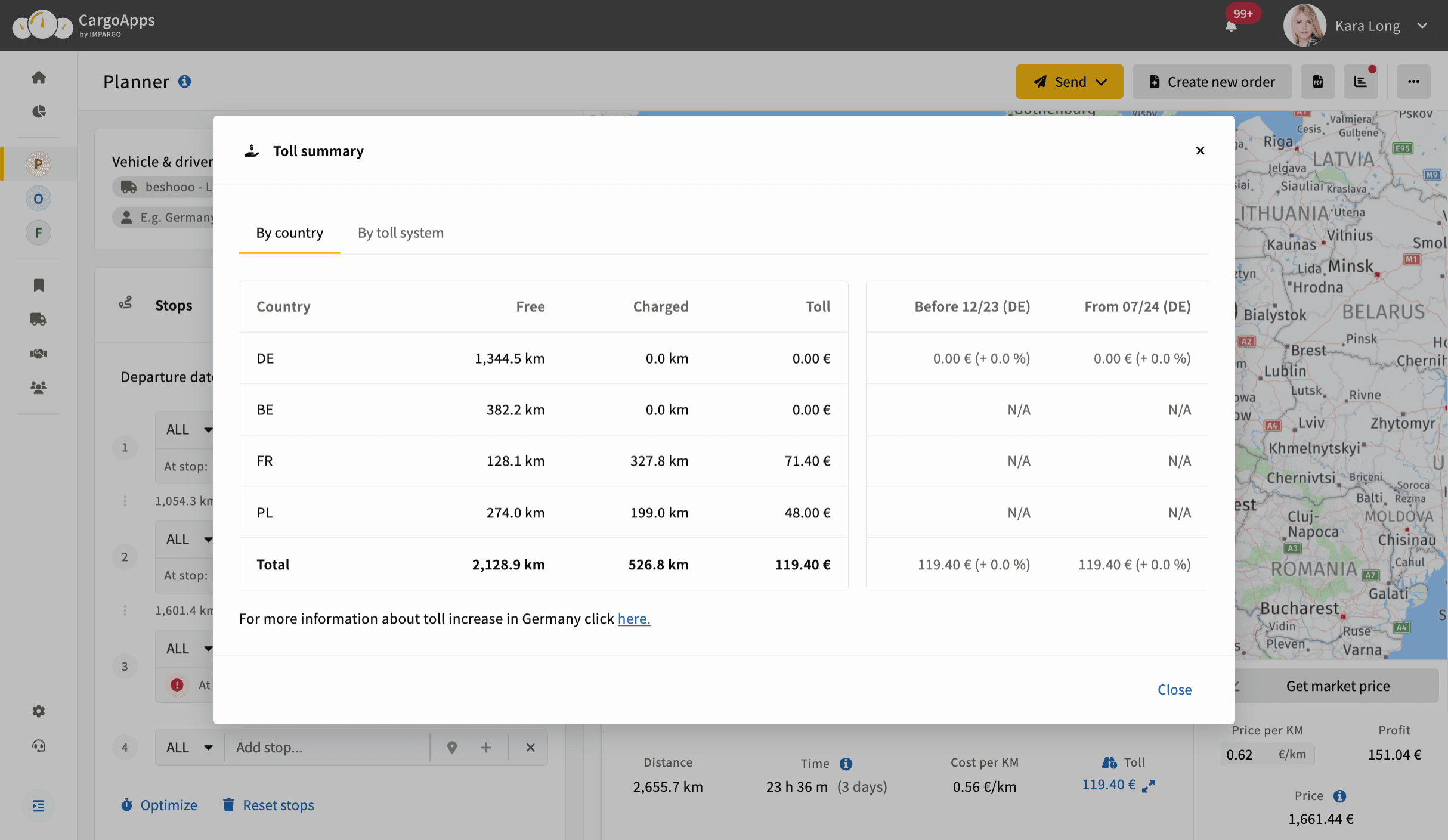
The hard part of Spanish tolls is not the rate — it is that the tolled network keeps changing and free-flow charges leave no booth receipt. A route priced from memory can carry a toll that was scrapped in 2021, or miss a free-flow charge that never showed at a barrier. The IMPARGO Planner Module calculates the Spanish toll by axle class and vehicle profile as part of the route cost — alongside France, Italy, Germany and the rest of Europe — with a country-by-country breakdown and a VAT toggle, so the dispatcher prices the corridor correctly at quote time instead of discovering the toll on the invoice.