Belgium Truck Toll: The Flanders CO₂ Surcharge Explained
Last verified: 1 July 2026
This guide explains what changed on 1 July 2026, who the CO₂ surcharge applies to, how the CO₂ class is set, the full rate tables by region, and how to price a Belgian route before the truck rolls.
What changed on 1 July 2026
The headline change is narrow and specific. A CO₂-emission surcharge was added to the kilometre-charge rates in the Flemish Region only. It sits on top of the rate a truck already pays for a given road, weight, and Euro class, through a new CO₂ class parameter.
Three points are worth keeping straight, because most summaries blur them:
- The CO₂ surcharge is Flanders only. Wallonia (the SOFICO network) and the Brussels-Capital Region did not introduce a CO₂ surcharge. Wallonia did adjust its rates and Brussels applied an indexation on the same date, so rates moved in all three regions, but only Flanders now prices by CO₂ class.
- Every OBU needs a CO₂ class, everywhere. From 1 July 2026, each on-board unit across all three regions has to carry a registered CO₂ emission class, even a truck that only runs in Wallonia or Brussels. If your OBU has no class registered, that is a compliance gap to close with your provider now.
- It is separate from the January indexation. Wallonia indexed its rates by about 1.91% on 1 January 2026, in line with the Belgian consumer price index. That was a routine indexation, not the July CO₂ change. The indexation cadence has also moved to 1 January, with no further indexation during 2026 and the next one due on 1 January 2027.
Everything else about Viapass carried over unchanged: the OBU obligation, the six accredited service providers, the three weight bands, and the Euro-class structure.
Who the CO₂ surcharge applies to
The surcharge targets a specific slice of the fleet. A truck is in scope when all three of these are true:
- Gross vehicle weight is over 3.5 t, the same threshold that has defined Viapass liability since 2016.
- The vehicle was first registered on or after 1 July 2019. This registration cut-off is the detail that trips people up. As a general rule, vehicles first registered before that date are automatically placed in CO₂ class 1, the reference class.
- The truck is driving on a tolled road in Flanders.
In practice this catches almost everyone at the top rate. Viapass reports that around 93% of vehicles currently fall in CO₂ class 1, and most diesel trucks from Euro 0 through Euro 6 sit there. Only some lower-consumption models reach class 2 or 3, and class 5 is reserved for zero-emission vehicles.
How the CO₂ class is determined
Belgium is extending its tariff classification to include a CO₂ class alongside the existing weight and Euro-standard dimensions. There are five classes, where class 1 is the least environmentally friendly reference category and class 5 is a zero-emission vehicle. The cleaner the vehicle, the lower the rate.
You do not work out the class by hand. Viapass provides an official CO₂ emission-class calculator that returns the class for a given vehicle from its registration and conformity documents, and the surcharge follows from there. A class 2 or 3 result is valid for six years after first registration, then re-checked.
Belgium truck toll rates 2026 (full tables)
The tables below show the Viapass per-kilometre rates in effect from 1 July 2026, by region, weight band, and Euro class. Two things to keep in mind while reading them. First, the CO₂ class changes the rate in Flanders only, so the Flanders table has extra rows for the CO₂ classes of a Euro 6 vehicle, while Wallonia and Brussels are priced on Euro class alone. Second, Wallonia rates are shown excluding VAT (the Walloon charge is a fee subject to VAT), while Flanders and Brussels are a tax with no VAT.
Wallonia (SOFICO network), €/km excluding VAT
Flanders (Flemish Region), €/km
Brussels-Capital Region, €/km
How the Belgian toll works
If you are new to the Belgian system, here is the structure the CO₂ change is layered onto. Belgium has charged a per-kilometre toll on trucks over 3.5 t since 1 April 2016, organised by the interregional authority Viapass across the three regions, Flanders, Wallonia, and Brussels. What you pay per kilometre depends on three factors:
- Region, since Flanders, Brussels, and the Walloon (SOFICO) network each set their own rates and rules.
- Gross vehicle weight, in three bands: over 3.5 t to 12 t, over 12 t to 32 t, and over 32 t.
- Euro emission standard, from Euro 0, the most polluting, to Euro 6, the cleanest.
An on-board unit (OBU) is mandatory and must be active whenever the truck is on a public road in any of the three regions, not only on tolled sections. Six accredited service providers issue OBUs for the Belgian charge: Axxès, Satellic, Telepass, Toll4Europe, TotalEnergies Marketing Services, and W.A.G. Payment Solutions. Driving without an active OBU carries a fine of up to €1,000, and enforcement runs through both gantry cameras and mobile teams that can stop trucks anywhere on the network.
How to calculate the toll cost of a route
Once the surcharge lands, Belgian cost per kilometre depends on one more variable, and it varies truck by truck. A newer vehicle in scope for the Flanders CO₂ surcharge and an older one on the same lane no longer cost the same to route through Flanders. Across a mixed-age fleet and a few regular Belgian lanes, that is no longer something you can eyeball, so it pays to price the toll into the route before the truck rolls.
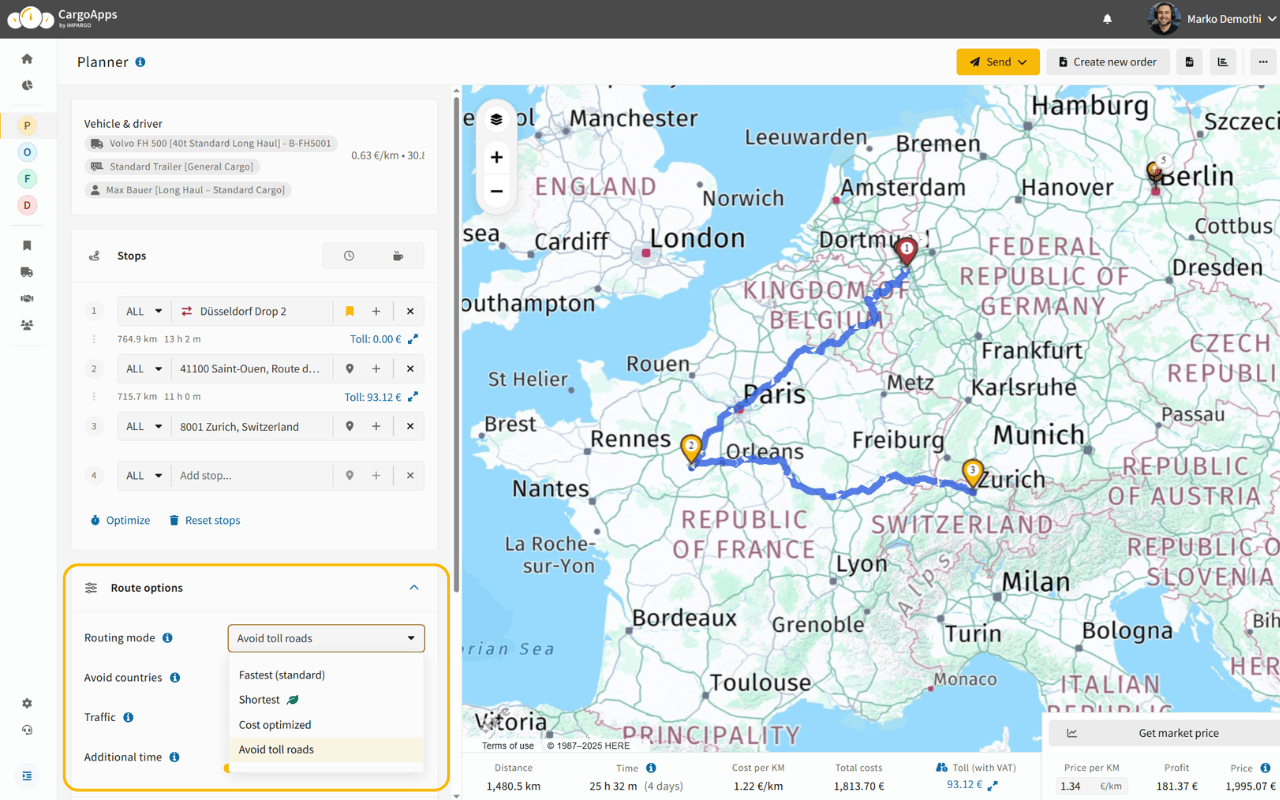
In IMPARGO, you can see the Belgian and Dutch toll for a route in a few steps:
- Open a route in the Planner Module and enable Traffic in Route Options.
- Set the departure date to a date on or after 1 July 2026, so the new rates apply.
- Read the updated Belgian toll in the results bar, next to the other countries on the route.
- Click Toll (with VAT) to open the toll summary.
- Open the By country tab for the full per-country breakdown.

The toll is only part of the picture. IMPARGO calculates per-country toll cost as part of the route, Belgium alongside Toll Collect in Germany, the French network, ASFINAG in Austria, and the rest of Europe, and folds it into the full cost of the trip with vehicle and driver costs. From the same route you can compare options with four routing modes, so you can weigh a Flanders run against the alternative before you commit a truck:
- Fastest, the quickest route by time.
- Shortest, the least distance regardless of road type.
- Cost optimized, the lowest total across vehicle, driver, and toll costs.
- Avoid toll, routing around tolled roads where a realistic alternative exists.
Once the trip is planned and priced, you can share a live tracking link so the customer follows the load without a phone call, and quote the Belgian run correctly from the start. When Belgian rates shift at the next indexation, the route cost reflects it without a manual rate hunt.
Why Belgium is doing this
The CO₂ surcharge follows directly from EU policy. The EU heavy-duty vehicle CO₂ standard requires manufacturers to cut new-truck CO₂ emissions by 45% by 2030, raised from an original 30% target, against a 2019 baseline, rising to 65% by 2035 and 90% by 2040. The revised Eurovignette framework lets member states differentiate road charges by a vehicle's CO₂ performance, and adding a CO₂ class to the tariff is Flanders applying that principle. Cleaner trucks pay less, higher-emitting trucks pay more, and the price signal nudges fleet renewal toward lower-emission vehicles.
For operators, the strategic read is simple. The direction of travel across Europe is toward CO₂-differentiated tolls, following countries such as Germany, Austria, and Denmark, so the age and emission profile of the fleet is becoming a direct route-cost lever, not just a compliance checkbox.
Two toll changes, one date
1 July 2026 is a double event for anyone running the Benelux corridor. On the same day the Flanders CO₂ surcharge took effect, the Netherlands launched its distance-based truck toll, the vrachtwagenheffing, replacing the Dutch Eurovignette with a per-kilometre charge. If your trucks cross between Belgium and the Netherlands, both changes hit the same lanes at once.
The Dutch system is a much larger change than the Belgian surcharge, a whole new charging regime rather than a tariff extension, with its own OBU rules, rate structure, and temporary discount. If you run into or through the Netherlands, read the companion guide: Netherlands truck toll 2026: the vrachtwagenheffing explained.
Belgium's change is smaller and more contained, but the underlying logic, charging by how clean the truck is, is the same one now spreading across the continent. Keeping route costs accurate as each country moves is the part that pays off in the quote.